In the high-stakes world of precision manufacturing, the difference between a functional masterpiece and a structural failure often lies in the smallest geometric details. Among these details, the choice between a countersink and a counterbore is one of the most fundamental decisions an engineer or machinist will make. While both features are designed to modify a hole to accommodate a fastener, they serve distinct mechanical purposes, require different tooling, and impact the final assembly’s aesthetics and integrity in unique ways.
This guide provides a deep dive into these two essential machining features, exploring their geometry, applications, and the technical considerations that dictate their use in industries ranging from aerospace to consumer electronics.
The Anatomy of Sub-Surface Fastening
To the untrained eye, a hole in a metal plate is simply a void. However, in mechanical engineering, a hole is a complex “feature” that interacts with other components to create a stable joint. When the goal is to have a fastener sit flush with or below the material surface, the entry point of the hole must be modified. This modification is where the distinction between countersinking and counterboring begins.
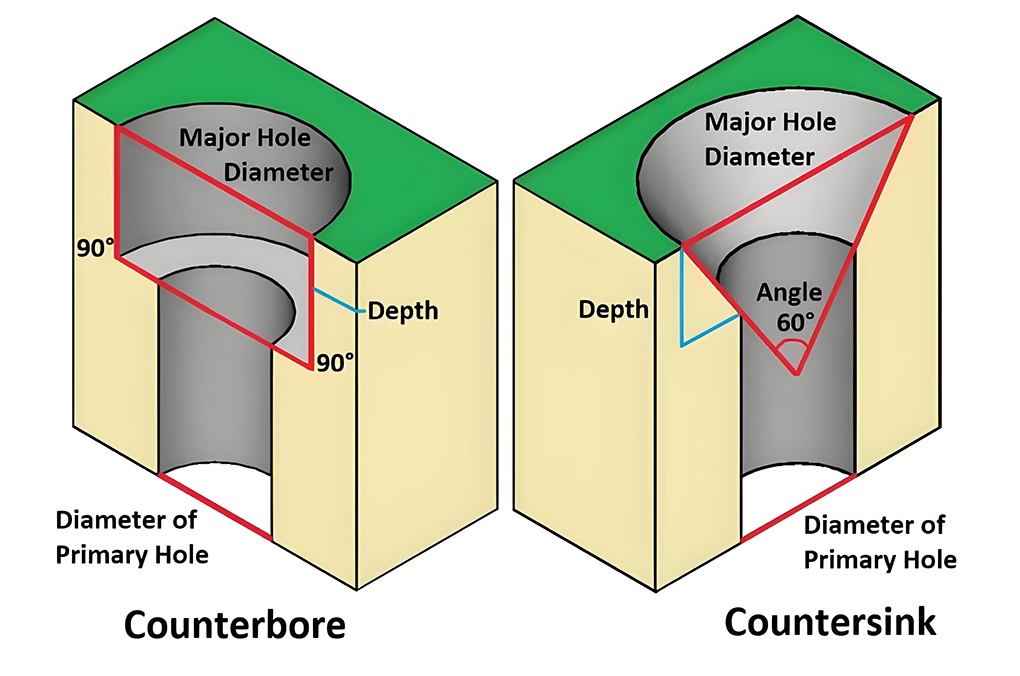
Defining the Counterbore Hole
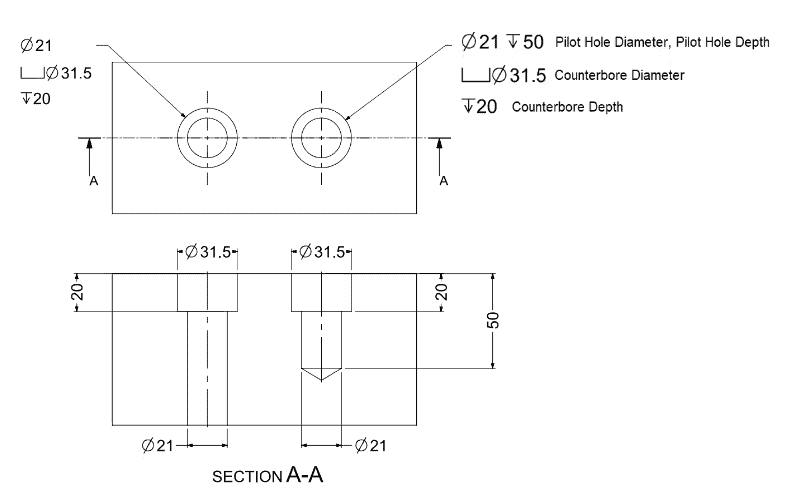
A counterbore is a cylindrical enlargement of the top portion of a pre-drilled hole (Practical Maintenance, n.d.). Imagine a “hole within a hole.” The counterbore creates a flat-bottomed recess that is wider than the main shaft of the hole. This flat shoulder at the bottom of the enlargement provides a critical bearing surface for the underside of a fastener’s head.
Geometry and Components:
- Large Cylinder: The upper, wider section that hosts the screw head, nut, or washer.
- Small Cylinder: The main hole that hosts the fastener’s thread or shank.
- The Shoulder: The flat, planar transition between the two cylinders that supports the axial load of the fastener.
Defining the Countersink Hole
In contrast, a countersink is a conical or beveled enlargement at the end of a hole (Practical Maintenance, n.d.). Instead of a flat shoulder, the countersink creates a tapered “flare” that matches the angled underside of a flat-head or tapered screw. The primary function here is to host a tapered head screw so that it rests perfectly flush with the surface.
Counterbore vs Countersink Hole: Difference Comparison Table
| Item | Counterbore (Flat-Bottom Hole) | Countersink (Conical Tapered Hole) |
| Shape | Cylindrical shape with a flat bottom | Conical/tapered shape |
| Purpose | Accommodates the head of bolts/screws or nuts so that they are flush with or below the surface | Accommodates flat-head screws so they are flush with the surface |
| Matching Fasteners | Hex bolts, socket head cap screws, washers, nuts, etc. | Flat-head screws, countersunk screws, pan-head screws, etc. |
| Machining Tools | End mills or specialized counterbore cutters | Conical countersink cutters |
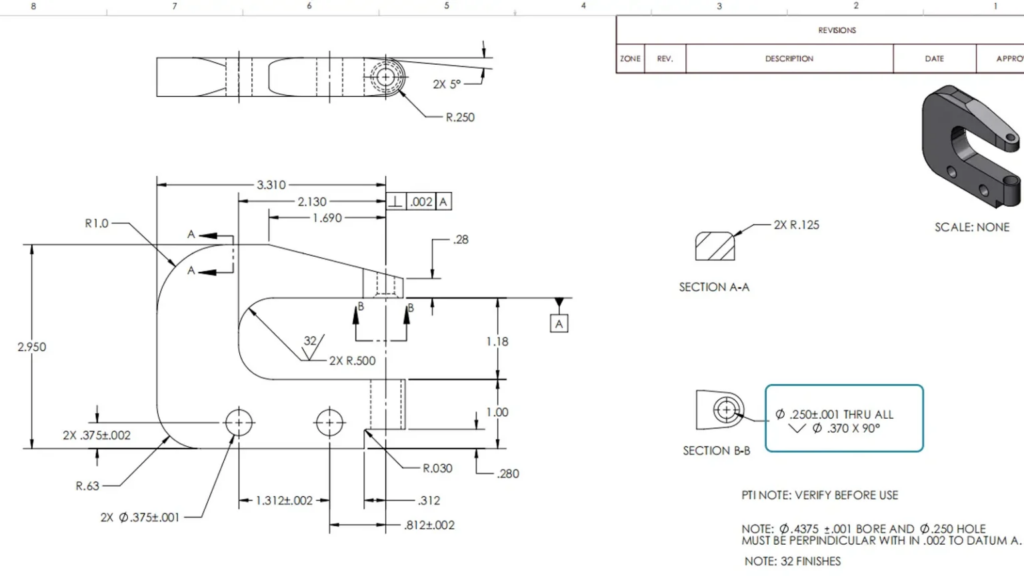
| Drawing Symbol | ⌴(A rectangle with a vertical line extending downward) | ⌵ (an inverted triangle) |
| Dimension Keywords | Diameter + Depth | Taper angle (e.g., 82°, 90°, 100°) + top diameter or depth |
| Typical Applications | Used in mechanical assemblies where bolt heads must sit flush or hidden | Common in applications requiring a clean, flush finish, such as in sheet metal, home appliances, or aerospace panels |
Engineering Applications and Fastener Compatibility
Choosing between these two features is rarely a matter of preference; it is almost always dictated by the type of fastener being used and the mechanical requirements of the joint.
When to Utilize Counterbores
Counterbores are typically paired with fasteners that have a flat-bottomed head, most notably Socket Head Cap Screws (SHCS). Because the counterbore provides a perpendicular bearing surface, it is exceptionally good at distributing clamping force evenly across a wide area.
- High-Strength Connections: In heavy machinery, counterbores allow recessing large bolt heads, protecting them from external impact while maintaining high torque capabilities.
- Space Constraints: When two moving parts must pass closely over one another, recessing a bolt head into a counterbore ensures there are no protruding “catch points” that could cause mechanical interference (Practical Maintenance, n.d.).
- Aesthetic Recessing: In high-end consumer products, counterbores allow nuts and washers hiddening deep within a casing, often followed by a plug or cap for a seamless finish.
When to Utilize Countersinks
Countersinks are the standard for Flat-Head Screws and Rivets. Their primary advantage is the ability to create a perfectly “flush” surface, which is critical in aerodynamics and precision assembly.
- Aerospace Structures: On the skin of an aircraft, even a millimeter of protrusion can cause significant drag. Countersunk rivets ensure the wing surface remains smooth.
- Woodworking and Cabinetry: To prevent snagging or to allow for decorative finishing, countersinks allow screws to sit just below the wood’s surface.
- Self-Centering: The conical shape of a countersink inherently helps center the fastener within the hole, which can be beneficial during rapid assembly.
Technical Challenges: Strength and Stress Distribution
While these features provide functional benefits, they also introduce “critical conditions” that can affect the structural integrity of a joint (Matson, n.d.). Engineers must account for the material removed and the stress concentrations created at the transition points.
The Knife-Edge Effect in Countersinks
A common risk with countersinking, particularly in thin materials, is the “knife-edge” condition. This occurs when the countersink depth is so great that it meets the bottom of the material, leaving virtually no straight-walled hole left to support the fastener. This can lead to a reduction in joint strength of up to 30% in certain composite-steel stack-ups (Matson, n.d.). For maximum bearing capacity, research suggests that a larger countersink angle and a smaller fillet radius often result in better ultimate strength.
Bearing Stress in Counterbores
Counterbores are generally more robust in thick materials because the flat shoulder handles axial loads more efficiently than a taper. However, if the counterbore is too deep relative to the material thickness, the “remaining” material may become a point of failure under high tension. Proper coaxiality—the alignment of the counterbore center with the hole center—is also vital; deviations beyond 0.3 mm can significantly alter the clamping force.
Machining the Perfect Hole: Tools and Process
Modern CNC machining has automated much of the complexity, but understanding the tooling is still essential for quality control.
- Counterbore Tools: These tools feature a “pilot” at the tip. The pilot fits into the existing hole to ensure the larger counterbore remains perfectly concentric with the original hole (Practical Maintenance, n.d.).
- Countersink Bits: These are typically categorized by their “included angle”—most commonly 82°, 90°, or 100°. Using a 90° bit for an 82° screw will result in poor contact and a weakened joint.
- On-Machine Measurement (OMM): In advanced manufacturing, using automation algorithms to inspect these features while the part is still on the CNC machine, ensuring the depth and diameter meet strict QC standards without removing the workpiece.
Conclusion: Elevating Your Manufacturing Standards
The choice between a countersink and a counterbore is a choice between flush-surface aerodynamics and high-load bearing capacity. Whether you are designing aerospace components that demand zero drag, and industrial frames that require the brute strength of recessed socket bolts, understanding these geometric nuances is the key to engineering excellence.
Precision is not merely an objective—it is a requirement. At SYM Machining, we specialize in the meticulous execution of complex hole features. We ensuring that every countersink is perfectly angled and every counterbore is machined to exact tolerances. Our state-of-the-art CNC capabilities and rigorous quality control processes mean your components will perform exactly as designed, every time.
Related Article:
PEEK vs. Delrin for CNC Machining
AL6061 vs. AL7075 Machining: Key Differences & Best Applications