Welcome back! In Part 1, we covered the chemistry, thermal performance, chemical resistance, and raw material sourcing for PEEK machined parts and Delrin machined parts. You learned about rod sizes, sheet dimensions, tube availability, colors, and the significant price difference between these two engineering plastics.
Now, in Part 2, we will focus on what happens when the raw material meets the cutting tool. We will compare mechanical properties, provide specific machining guidelines, explore real-world applications, and help you make a final selection based on your industry—whether you work in medical device manufacturing, aerospace components, or general industrial automation.
Mechanical Properties: Strength, Stiffness, and Wear
When comparing PEEK machined parts versus Delrin machined parts, the mechanical requirements of the application dictate the choice.
Tensile Strength and Stiffness
PEEK is the clear winner in high-stress environments. Unfilled PEEK typically offers a tensile strength of around 14,000 psi, while glass- or carbon-filled variants can exceed 30,000 psi. Delrin offers respectable tensile strength—approximately 10,000 psi—but it softens and loses stiffness at elevated temperatures far sooner than PEEK.
For components that must maintain structural integrity under continuous load at room temperature, Delrin is often sufficient. However, for applications involving sustained stress, high impact, or elevated temperatures, PEEK is the superior choice.
Friction and Wear
Both materials are favored for bearing and wear applications, but they behave differently.
Delrin has a very low dynamic coefficient of friction (around 0.2 against steel), and we often use it for gears, bushings, and conveyor components. It runs quietly against metal counterparts and requires minimal lubrication.
PEEK, particularly when reinforced with carbon fiber, offers exceptional wear resistance and a lower coefficient of friction than Delrin in high-load or high-temperature scenarios. While Delrin may perform better in clean, room-temperature environments, PEEK excels in dirty, abrasive, or high-PV (pressure-velocity) applications.
Precision Engineering and Machinability
Both materials are considered excellent candidates for precision engineering, but their machining behaviors differ significantly.
Machining Delrin
Delrin is often described as one of the most machinable plastics. It produces long, continuous chips that are easily evacuated from the cutting zone. It maintains tight tolerances (±0.001 inches or better) without requiring extensive post-machining stress relief. However, because Delrin has a relatively low melting point, machinists must avoid excessive heat buildup, which can cause localized melting or burr formation.
Key considerations for Delrin machining:
- Sharp, polished cutting tools are essential.
- Adequate chip evacuation prevents re-cutting.
- Cooling is recommended to maintain dimensional accuracy.
Machining PEEK
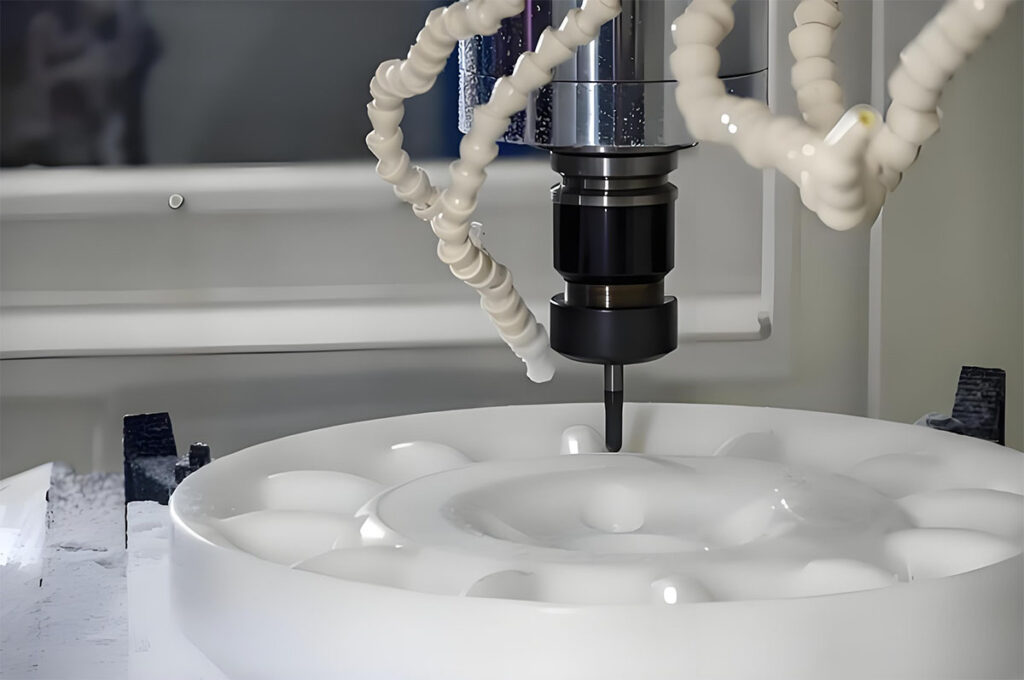
Machining PEEK requires greater expertise. While it machines cleanly, it is more abrasive—especially when glass- or carbon-filled—and generates significant heat during cutting. Without proper cooling and tool selection, PEEK can work-harden or develop residual stresses that lead to warping.
Key considerations for PEEK machined parts:
- Carbide or diamond-coated tools are recommended for filled grades.
- Flood coolant is often necessary to dissipate heat.
- Stress-relieving the material before machining improves dimensional stability.
- Tighter process controls are required to achieve tolerances below ±0.0005 inches
Application Deep Dive: Where Each Material Excels
Common Applications for Delrin Machined Parts
Delrin is the go-to material for high-volume, cost-sensitive applications where thermal extremes are not a factor.
- Gears and Bearings:Delrin’s low friction and high fatigue resistance make it ideal for precision gears, bushings, and cams.
- Conveyor Components:Its low wear and non-stick surface are valued in food processing and packaging machinery.
- Automotive Components:Fuel system components, seatbelt mechanisms, and door latch systems.
- Consumer Products:Zippers, knife handles, and pump housings.
- Valve and Pump Components:Valve seats, seals, and impellers for water and mild chemical applications.
Common Applications for PEEK Machined Parts
PEEK machined parts are specified for mission-critical applications where failure is not an option.
- Medical Device Manufacturing:Surgical instruments, orthopedic implants, and dental components. PEEK’s biocompatibility, radiolucency (invisible on X-rays), and sterilization resistance are unmatched by Delrin.
- Aerospace Components:Brackets, fasteners, and insulation components. PEEK reduces weight while meeting FAA flammability standards.
- Semiconductor and Electronics:Wafer handling components and electrical connectors. PEEK’s low outgassing and high purity are critical here.
- Oil and Gas:Seals, bushings, and backup rings in downhole tools. PEEK resists high pressure, high temperature, and aggressive chemicals.
- Fluid Transfer Systems:PEEK tubes are used in chemical processing, pharmaceutical, and analytical instrumentation.
Cost Considerations and Value Engineering
There is a significant cost disparity between Delrin and PEEK. As we established in Part 1, PEEK is typically 8 to 20 times more expensive than Delrin.
However, focusing solely on raw material cost is a mistake in precision engineering. The total cost of ownership must consider:
- Longevity:A PEEK component that lasts ten years in a harsh environment may be far more economical than replacing a Delrin component annually.
- Risk Mitigation:In industries like medical device manufacturing and aerospace components, the cost of field failure is exponentially higher than the initial material savings.
- Processing Costs:Delrin machines faster and with less tool wear, reducing per-part machining time. PEEK requires slower feeds, specialized tooling, and more rigorous quality control.
For high-volume consumer or industrial applications at ambient temperatures, Delrin machined parts offer an unbeatable value proposition. For low-volume, high-reliability applications in extreme environments, PEEK machined parts justify their premium price.
Final Selection Guide: Delrin or PEEK?
Choose Delrin if:
- Your application operates below 80°C (176°F).
- You need a cost-effective, low-friction material.
- Chemical exposure is limited to mild environments.
- You are producing high-volume precision components.
- You need readily available stock shapes in large dimensions (up to 8″ rod, 48″ x 120″ sheet).
Choose PEEK if:
- Your application involves high temperatures or thermal cycling.
- Exposure to harsh chemicals, steam, or sterilization is required.
- You need a material with high strength-to-weight ratio.
- You are developing mission-critical components for medical, aerospace, or semiconductor industries.
- You require tube forms or filled grades for wear or ESD applications.
Conclusion: Your Partner for Precision Plastic Machining
Choosing between PEEK and Delrin ultimately depends on your operating environment, performance requirements, and budget. Both materials have earned their place in modern manufacturing—Delrin for its machinability and value, PEEK for its extreme performance.
Regardless of which material you select, the success of your project depends on partnering with a machinist who understands the nuances of plastic machining. From tool geometry to thermal management, precision matters.
If you’re ready to move from design to production—whether you need high-tolerance Delrin machined parts or high-performance PEEK machined parts—our team specializes in delivering precision engineering solutions tailored to your industry.
Let’s discuss your next project. Contact us today.