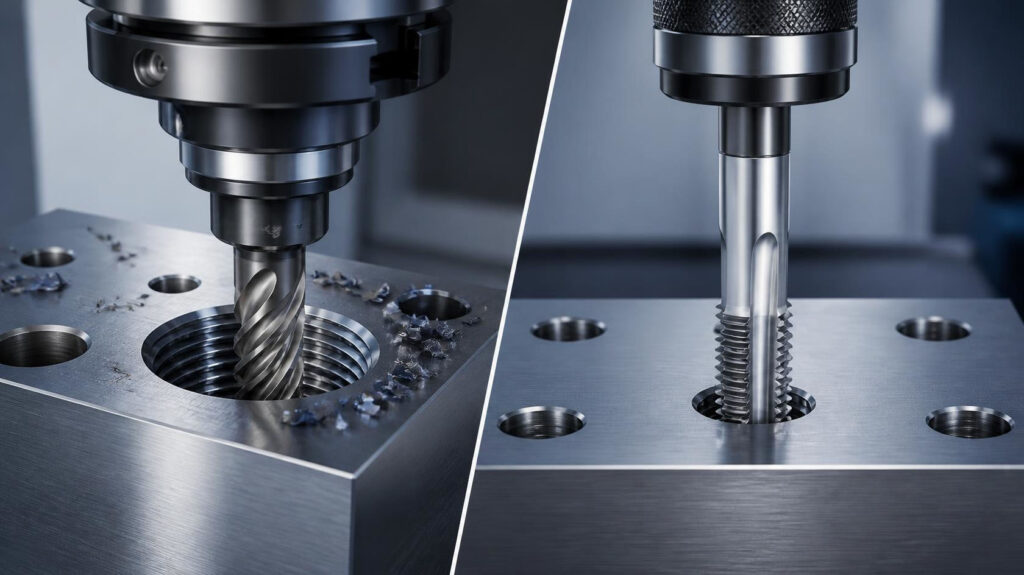
Creating internal and external threads stands among the most critical operations in modern machining. Precision CNC facilities must select the right thread generation method to control costs and safeguard parts. Two dominant manufacturing techniques handle the vast majority of industrial thread production: thread milling and tapping. While both processes produce standard thread profiles, their underlying kinematics and tooling requirements differ significantly. Understanding these technical distinctions enables engineers to make smarter choices for specific part geometries and material hardness levels.
1. Mechanics and Tooling Fundamentals
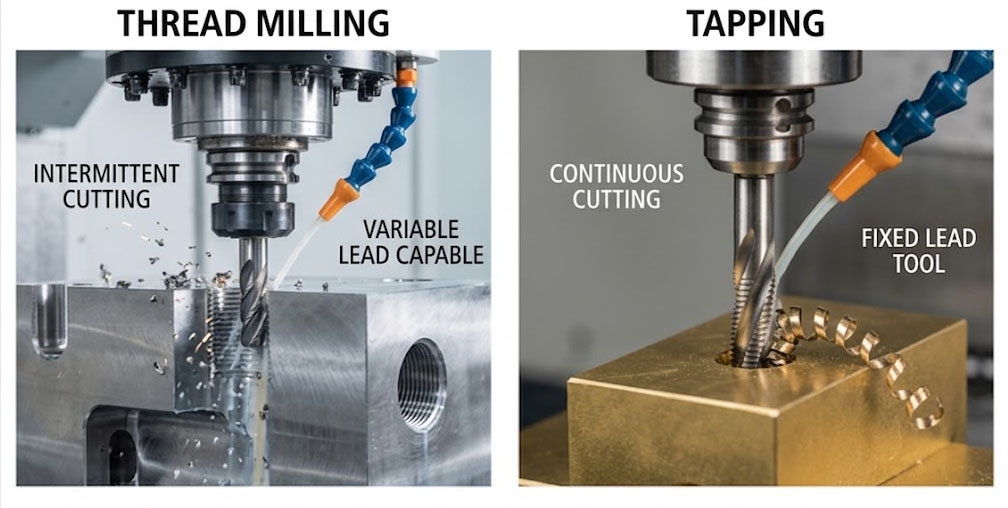
Engineers must analyze how each cutting tool forms metal threads before selecting a process. Tapping represents a traditional, highly efficient machining method using a multi-fluted cutting tool. The tap geometry features the exact thread profile ground directly into its cutting edges. During tapping, the tool feeds axially into a hole at a rate matching the thread pitch. The tap engages the entire hole perimeter simultaneously, cutting all threads in a single continuous stroke.
Standard cut taps remove metal swarf through helical flutes, directing chips out of the hole. Roll-form taps plastically deform workpiece material without generating metal chips. Because each tap matches one hole diameter and pitch, every thread size requires a dedicated tap.
Thread milling operates on an entirely different kinematic principle using modern multi-axis CNC machine tools. A thread mill features a cutting tool diameter smaller than the target internal hole. The tool enters the hole, moves to depth, and interpolates spirally around the perimeter.
The CNC machine executes a simultaneous three-axis helical movement to generate precise thread forms. This flexible motion allows one thread mill to cut various thread diameters with identical pitches. Furthermore, operators can easily switch between right-hand and left-hand threads using simple G-code adjustments.
2. Chip Control and Machining Kinematics
Effective chip evacuation determines the stability and final quality of internal thread machining operations. Tapping internal threads creates significant friction and chip packing risks, particularly inside blind holes. Cut taps generate continuous helical chips that must exit through narrow tool flutes during cutting. Trapped metal chips can bind against hole walls, causing thread distortion or sudden tap breakage. While roll-forming taps eliminate chips, they demand higher machine torque and require ductile materials.
Thread milling provides exceptional chip control through its unique cutting dynamics and intermittent contact. Because the cutter diameter is smaller than the hole, ample clearance exists for continuous chip flushing. High-speed cutter rotation breaks metal chips into small, manageable fragments that exit easily with coolant.
Intermittent tool engagement reduces heat accumulation, preserving workpiece structural integrity and tool life. Consequently, thread milling eliminates chip packing hazards in deep blind holes and tough superalloys. This reliable chip clearance guarantees superior surface finishes and supports fully automated CNC production runs.
3. Tool Wear, Breakage, and Workpiece Risk
Tool breakage represents one of the most costly disruptions in high-precision component manufacturing. When a conventional tap breaks inside a workpiece, the tool locks tightly within the hole. Removing a broken tap requires wire EDM processing, chemical etching, or manual grinding. These extraction methods often ruin expensive parts, leading to complete component scrap and lost production time. Furthermore, as taps wear, thread dimensions drift rapidly, making pitch diameter control increasingly difficult.
Thread milling dramatically reduces the financial and operational risks associated with tool failure. Should a thread mill break, the cutter does not lock into the workpiece structure. Because the cutter diameter remains smaller than the hole, operators easily extract broken tool pieces. Machinists then replace the cutter, adjust offset settings, and re-run the program safely. Additionally, CNC operators adjust tool radius offsets to compensate for wear, maintaining tight tolerances consistently.
4. Hole Depth, Size Versatility, and Material Hardness
Material properties and feature geometry strongly dictate the selection between tapping and thread milling. Tapping excels in high-volume production of standard hole sizes, especially in soft aluminum and steel. The process delivers extremely fast cycle times by cutting full thread depth in one pass. However, tapping becomes risky in hardened steels, titanium alloys, or nickel-based metals exceeding 45 HRC. Extreme cutting forces and friction cause rapid tap wear, severe chatter, and catastrophic tool failure.
Thread milling excels when machining difficult materials and non-standard thread requirements with high precision. Solid carbide thread mills easily machine hardened steels up to 65 HRC without premature failure. The process also cuts threads extremely close to blind hole bottoms, leaving minimal incomplete threads. Because thread milling relies on programmable tool paths, one tool produces internal and external threads. This versatility drastically reduces tooling inventory requirements and setup times across diverse job lots.
5. Economic Considerations and Technical Comparison
Evaluating total production costs requires balancing initial tool investments against cycle times and scrap risks. Taps feature lower initial purchase prices, making them attractive for simple manufacturing jobs. Tapping cycles run faster than thread milling, delivering cost efficiency in high-volume ductile material production. However, hidden costs accumulate when factoring in part scrap, frequent tool changes, and large tap inventories.
Thread milling requires higher initial tooling investments and slightly longer cycle times per threaded feature. Nevertheless, thread milling yields lower total cost per part when producing high-value, complex components. One thread mill replaces multiple tap sizes, decreasing inventory complexity and simplifying CNC tool management. Moreover, near-zero scrap risk protects expensive workpieces, making thread milling highly economical for high-stakes projects.
Technical & Process Comparison: Thread Milling vs. Tapping
| Feature / Metric | Thread Milling | Tapping (Cut & Form Taps) |
| Kinematic Principle | Multi-axis helical CNC interpolation (tool rotates and orbits axially) | Single-pass linear axial feed matched to thread pitch |
| Tool Diameter vs. Hole Size | Tool diameter is smaller than the target hole diameter | Tool diameter matches the exact target hole diameter |
| Diameter Flexibility | High: One tool cuts multiple diameters (same pitch/profile) | Low: Requires a specific tap size for each hole diameter |
| Hand of Thread | Can cut right-hand and left-hand threads with the same tool | Requires separate right-hand and left-hand taps |
| Chip Clearance & Control | Superior: Small tool leaves wide clearance space; breaks short chips | Risk-Prone: Continuous chips exit via narrow flutes; risk of chip packing |
| Tool Breakage Consequence | Low Risk: Tool easily clears hole; part is saved and program rerun | High Risk: Broken tap binds in workpiece; often leads to part scrap |
| Material Hardness Capability | Handles hardened materials up to 65 HRC (solid carbide) | Best for softer materials; struggles above 45 HRC |
| Blind Hole Bottom Clearance | Excellent (can machine threads within 1 pitch from hole bottom) | Requires lead chamfer depth clearance at hole bottom |
| Pitch Diameter Control | High: Adjustable via CNC tool radius offsets (D-offset) | Fixed by physical tap dimensions; shifts as tap wears |
| Cycle Time Speed | Slower per thread pass | Extremely fast single-pass execution |
| Ideal Production Volume | Low-to-medium volumes, prototype jobbing, high-value components | High-volume mass production of standard fasteners |
| Initial Tooling Cost | Higher initial investment per solid carbide cutter | Lower cost per standard tap |
| Overall Scrap Risk | Near-zero component scrap risk | Moderate-to-high scrap risk on high-value parts |
6. Process Selection Criteria for Machining Applications
Selecting between thread milling and tapping requires analyzing key project requirements, materials, and risk tolerance. High-volume automotive facilities machining soft steel fittings benefit from the speed and low cost of tapping. Conversely, precision job shops handling aerospace components, medical devices, or complex molds should select thread milling. Evaluating machine capabilities, hole depths, and material hardness ensures smooth shop floor integration and maximum profitability.
7. Strategic Threading Solutions for Complex Components
Modern manufacturing demands careful alignment between cutting tools, CNC programming, and material characteristics. Complex internal geometries and tight tolerance standards require precise tool path calculations and robust cutting strategies. Machine shops must analyze production batch sizes and cycle time goals before choosing cutting tools. Combining proper coolant delivery with accurate speed and feed settings extends tool life significantly. Experienced manufacturing partners assist engineers in optimizing thread quality while eliminating costly production delays.
8. Quality Control and Thread Inspection Standards
Maintaining consistent thread quality requires rigorous inspection methods and strict process monitoring across production runs. Machinists utilize go/no-go thread plug gages to verify pitch diameter compliance on the floor. Optical comparators and thread measuring wires provide detailed measurements for critical defense and medical components. Thread milling allows subtle tool offset adjustments to correct thread fit without changing cutting tools. This fine-tuning capability helps manufacturers maintain tight ISO and UN thread class tolerances reliably.
9. Advanced Tooling Materials and Coating Technologies
Recent advancements in tooling materials have expanded the capabilities of both taps and thread mills. Modern solid carbide formulations and specialized ceramic coatings withstand extreme cutting temperatures during heavy machining operations. Titanium aluminum nitride coatings reduce friction and prevent built-up edge formation on cutting surfaces. Custom tool geometries feature variable helix angles to minimize chatter and improve surface finish quality. Investing in premium coated tooling enhances tool longevity and ensures stable performance in tough alloys.
10. Optimizing Machine Tool Rigidity and Setup
Successful thread production relies heavily on total machining system rigidity and precise spindle alignment. Spindle runout and tool holder deflection cause uneven tooth loading and premature cutting edge failure. Rigid tool holding systems, such as hydraulic chucks or shrink-fit holders, optimize machining stability. High-pressure coolant systems flush chips effectively while cooling active cutting zones during deep hole operations. Proper machine setup minimizes vibration, extends tool life, and guarantees high thread accuracy on every workpiece.
Partner with SYM Machining for Precision Manufacturing Solutions
Achieving flawless thread quality and tight tolerances requires advanced equipment, specialized tooling expertise, and rigorous quality control. At SYM Machining, we specialize in high-precision CNC milling, turning, and custom thread manufacturing for demanding industries. Our engineering team selects optimal machining processes for your specific part geometries, ensuring maximum efficiency and accuracy. Whether your project requires high-volume tapped components or complex thread-milled features, SYM Machining delivers reliable excellence. Contact SYM Machining today to request a competitive quote and discuss your custom manufacturing needs with our technical specialists.