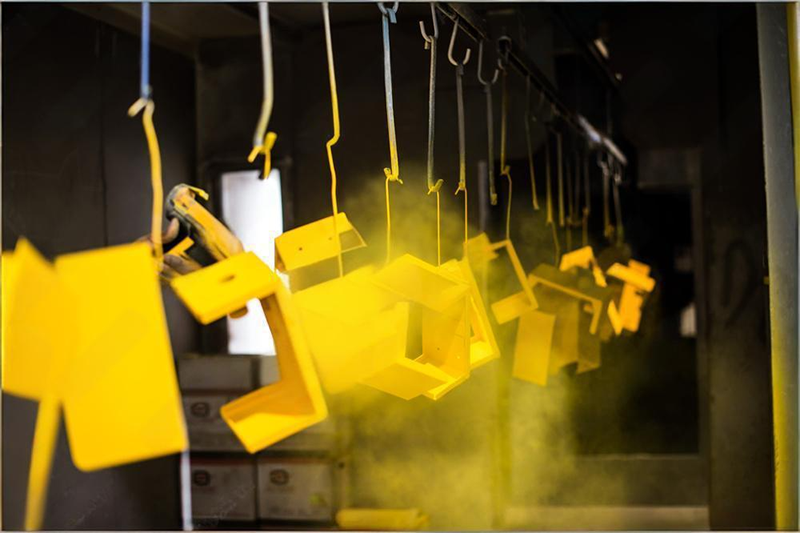
For metal machined parts, except the plating requirement for surface finish, some times, the customer request powder coating or painting for their machining needs.
This article explains what pre-treatment is for machined parts, why it matters, and how it differs for powder coating and liquid painting. It also covers precision areas, masking techniques, and surface-only painting requirements, helping you achieve reliable and professional finishing results.
Introduction
Powder coating and liquid painting are widely used surface finishing methods in manufacturing. They improve the appearance of parts and protect them from corrosion, wear, and environmental damage. However, the quality of any coating depends heavily on proper pre-treatment.
Without the right pre-treatment, even the best powder coating or paint can peel, bubble, or fail early. For precision machined parts, pre-treatment becomes even more critical. Some areas must be coated, while others must stay clean and accurate. In these cases, masking is required to protect precise locations.
What Is Pre-Treatment in Surface Finishing
Pre-treatment is the process of cleaning and preparing a part’s surface before applying powder coating or liquid paint. Its main purpose is to ensure strong adhesion and long-lasting performance of the coating.
Main Goals of Pre-Treatment
- Remove oil, grease, dirt, and cutting fluids
- Eliminate rust, oxides, and surface contaminants
- Create a surface that helps coating stick well
- Improve corrosion resistance
- Ensure consistent color and finish quality
Without proper pre-treatment, coatings may look fine at first but fail during use.
Why Pre-Treatment Is Critical for Powder Coating and Painting
Both powder coating and liquid painting require clean and controlled surfaces, but they react differently to surface conditions.
Problems Caused by Poor Pre-Treatment
- Peeling or flaking coating
- Blisters and bubbles
- Uneven thickness
- Poor corrosion resistance
- Shortened service life
For precision parts, poor pre-treatment can also affect dimensions and functional surfaces, leading to assembly problems.
Key Differences Between Powder Coating and Painting
Before discussing pre-treatment steps, it is important to understand how powder coating and liquid painting differ.
Powder Coating
- Uses dry powder applied electrostatically
- Cured at high temperature (160–200°C)
- Produces thicker and more durable coatings
- Less precise in coating control
- Masking often required for tight tolerances
Painting
- Uses liquid paint sprayed onto surfaces
- Cured at room temperature or low heat
- Allows thinner and more precise coating control
- Better for detailed or cosmetic surfaces
- Usually applied only to outer surfaces
Common Pre-Treatment Steps for Both Processes
Although powder coating and painting have differences, many pre-treatment steps are shared.
1. Degreasing and Cleaning
Machined parts often contain oil, coolant, and fingerprints. These must be removed first.
Common cleaning methods include:
- Alkaline cleaning
- Solvent cleaning
- Aqueous washing
- Ultrasonic cleaning for precision parts
Clean surfaces allow coatings to bond correctly.
2. Rinsing
After cleaning, parts must be thoroughly rinsed with clean water to remove chemical residues. Any leftover chemicals can cause coating defects.
3. Surface Conditioning
Surface conditioning improves coating adhesion by slightly roughening the surface.
Methods include:
- Acid pickling
- Phosphate treatment
- Chromate or non-chrome conversion coatings
This step is especially important for steel and aluminum parts.
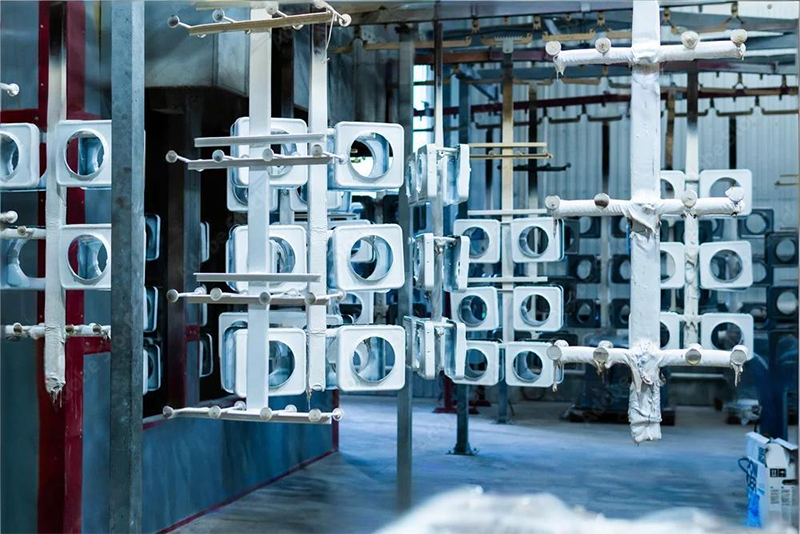
Powder coating VS. Painting
Quick Summary: Key Difference
The fundamental difference is in the application method and curing:
- Powder Coating:Electrostatically applied dry powder, then heat-cured into a hard finish.
- Liquid Painting:Applied as a wet solvent- or water-based coating, then air-dried or heat-cured.
Powder Coating: In-Depth
Process: Dry, free-flowing powder is sprayed using an electrostatic gun (giving the part a positive charge, the powder a negative charge). The charged powder adheres to the part. It is then baked in an oven, where it melts, flows, and chemically cross-links to form a durable skin.
Advantages:
- Durability & Thickness:Extremely hard, chemical-resistant, and impact-resistant finish. Typically applied thicker (2-4 mils/50-100 microns) in a single coat without runs or sags. Superior for parts subject to wear, corrosion, or outdoor exposure.
- Efficiency & Material Use:Near 100% overspray recovery (unused powder can be collected and reused). No material waste from solvents.
- Environmental & Safety:Contains no solvents (VOCs – Volatile Organic Compounds). Minimal hazardous waste, safer storage, reduced fire risk.
- Appearance:Excellent uniformity, especially on flat surfaces and edges. Wide range of textures (smooth, wrinkled, hammered) and special effects (metallics, clear coats).
- Production Speed:Curing is fast (typically 10-30 minutes in oven).
Disadvantages:
- Upfront Cost:Higher capital investment for booth, oven, and application equipment.
- Part Size & Material:Limited by oven size. Not suitable for heat-sensitive materials (plastic, some alloys).
- Thin Films:Difficult to achieve very thin films (<1 mil) like those in automotive coatings.
- Color Change:Slower and more labor-intensive to change colors in the booth compared to liquid paint.
- Touch-ups:Can be more difficult to touch up seamlessly in the field.
Liquid Painting: In-Depth
Process: Paint (solvent-based, water-based, or urethane) is applied via spray gun, dip, or brush. It forms a film through solvent evaporation, chemical reaction, or oxidative cross-linking. May require primers and multiple coats.
Advantages:
- Versatility & Substrates:Can be applied to any material—metal, plastic, wood, composites—and any size (no oven limit for air-dry paints).
- Finish & Aesthetics:Can achieve extremely thin, smooth films (e.g., 0.5-1 mil for automotive). Unmatched for high-gloss, deep-wet looks. Superior color matching and blending.
- Flexibility:Generally more flexible, which can be critical for parts that bend or flex.
- Low-Volume & Touch-Ups:Ideal for prototypes, custom jobs, and on-site repairs. Color changes are fast.
- Lower Initial Investment:Basic spray equipment is less expensive.
Disadvantages:
- Material Waste & VOCs:Significant overspray (30-50% loss). Solvent-based paints emit high VOCs, requiring expensive environmental controls and permits.
- Durability:Typically thinner and less abrasion/chemical resistant than powder coat. More prone to runs, sags, and orange peel.
- Production Time:Often requires multiple coats (primer, base, clear) with flash-off times between. Air drying can be slow.
- Environmental/Safety Hazards:Flammable materials, hazardous waste, and greater health risks for workers (respirators required).
Head-to-Head Comparison Table
| Feature | Powder Coating | Liquid Painting |
| Typical Thickness | 2-4 mils (50-100µm) | 0.5-2 mils (13-50µm) |
| Durability | Excellent – Hard, abrasion, and chemical resistant. | Good to Very Good – More prone to chips and wear. |
| Aesthetic Range | Great for colors & textures. Can have slight “orange peel”. | Superior for ultra-smooth, high-gloss, and complex finishes. |
| Material Efficiency | Excellent (~99% overspray reclaim). | Poor (High overspray loss). |
| Environmental Impact | Low – Near-zero VOCs, less waste. | High (Solvent-based) to Moderate (Water-based) VOCs. |
| Substrate Flexibility | Limited – Conductive, heat-resistant metals only. | Universal – Metal, plastic, wood, etc. |
| Application Speed | Fast curing, but batch process. | Can be slower due to multi-coats and dry times. |
| Color Change Speed | Slow (requires booth cleanup). | Fast. |
| Cost for High Volume | Lower per-part cost (material reuse, durability). | Higher per-part cost (material waste, labor). |
| Initial Setup Cost | High (oven, booth, electrostatic system). | Low to Moderate. |
Applications of Powder Coating and Painting
Powder Coating Applications
- Industrial frames
- Brackets and supports
- Outdoor equipment
- Heavy-duty components
Liquid Painting Applications
- Electronic housings
- Automotive trim
- Decorative panels
- Precision machined enclosures
Conclusion
Pre-treatment is the foundation of successful powder coating and liquid painting. Without it, coatings cannot perform as expected.
Powder coating offers strength and durability, but it is less precise, making masking necessary for critical areas. Liquid painting provides better control, especially when painting only the outer surface of a part.
By understanding material requirements, precision needs, and masking strategies, manufacturers can choose the right pre-treatment process and achieve reliable, long-lasting finishes.
Investing in proper pre-treatment is not an added cost—it is a quality assurance step that protects performance, appearance, and customer satisfaction.
At SYM, we specialize in manufacturing different kinds of metal and providing them with the final finishing looks that suit your needs. If you’re contemplating the metal finishing to use, we have expert teams that are always available to help.
Related articles:
What is Nickel Plating? Essential Guide