When it comes to protecting metal surfaces and enhancing their appearance, two popular options are black oxide and anodizing. These finishes are often used in industries like aerospace, automotive, and machinery to provide corrosion resistance, durability, and an attractive black finish. However, the choice between the two processes can be tricky. Both offer distinct benefits, but they serve different needs and have unique characteristics.
In this article, we’ll compare black oxide and anodizing, discussing the differences between them, their applications, and how to decide which is the best choice for your project. Whether you’re working with aluminum, steel, or other metals, understanding these finishes can help you make an informed decision.
What is Black Oxide?
Black oxide is a conversion coating process that forms a thin, protective layer on the surface of ferrous metals (like steel), as well as non-ferrous metals such as copper and brass. The process involves a chemical reaction in which the metal surface is exposed to an oxidizing solution, typically alkaline or acidic, to create a thin black coating.
How the Black Oxide Process Works
The black oxide process is straightforward and efficient. It starts with thoroughly cleaning the metal to remove any oils or contaminants. The part is then immersed in a specialized, heated chemical bath containing salts and water. This bath reacts with the iron on the surface of the metal to form a magnetite (Fe₃O₄) layer. This resulting oxide layer is what gives the metal its characteristic deep black, matte appearance. It’s important to note that the coating is very thin, typically only 0.0002 to 0.0004 inches, and it doesn’t alter the part’s dimensions.
Key Advantages of Black Oxide
- Affordable Cost:Black oxide is one of the most cost-effective metal finishing options available, especially compared to processes like anodizing.
- Sleek Appearance:It provides a uniform, matte black finish that is both aesthetically pleasing and reduces light glare.
- Added Lubricity:The coating can be impregnated with oil or wax, which provides a slight increase in wear and abrasion resistance.
- Dimensional Stability:Because the coating is so thin, black oxide does not change the size or threading of precision parts.
Understanding the Limitations
While beneficial, black oxide is not perfect for every situation. Its primary limitations are:
- Moderate Corrosion Resistance:The coating itself offers only a basic barrier against rust. Its corrosion resistance is significantly enhanced by a final step of applying oil or wax. However, it is not suitable for harsh environments like marine applications without frequent maintenance.
- Can Wear Over Time:The thin coating may wear off if the part is subject to heavy friction or abrasion.

What is Anodizing?
Anodizing is an electrochemical process that thickens the natural oxide layer on metals, especially aluminum. Unlike black oxide, anodizing involves passing an electric current through the metal while immersed in an acid bath, which causes the surface of the metal to oxidize. This process not only thickens the oxide layer but also changes its structure, making it much more durable and corrosion-resistant.
How Anodizing Works
The process begins with cleaning the aluminum substrate. It’s then submerged in an electrolyte bath (typically sulfuric acid), where an electrical current is applied. This current stimulates controlled oxidation, growing a thick, porous aluminum oxide layer that’s integral to the metal itself – not just a surface coating.
Key Advantages of anodize
• Exceptional Durability: The hard oxide surface resists wear and corrosion, outperforming most coatings
• Superior Weather Resistance: Withstands harsh environments, including marine applications
• Color Versatility: The porous layer accepts dyes for virtually any color before sealing
• Enhanced Safety: Non-toxic, non-flammable finish free from heavy metals
• Environmental Benefits: More eco-friendly than chrome plating or similar processes
Limitations
• Higher Cost: Anodizing tends to be more costly compared to black oxide due to the more complex process.
• Not applicable to all metals:: While anodizing is perfect for aluminum, it is not effective on steel or other metals.
• Electrical Dependency: Requires substantial energy input for the process.
Black Oxide vs. Anodizing: A Comparison
Both black oxide and anodizing can provide a black finish for metals, but they differ significantly in terms of their processes, benefits, and applications. Here’s a breakdown of how the two finishes compare:
| Feature | Black Oxide | Anodizing |
| Process | Chemical conversion coating | Electrochemical oxidation |
| Best for | Steel, copper, brass, and other ferrous/non-ferrous metals | Primarily aluminum |
| Corrosion Resistance | Moderate | Excellent (especially for aluminum) |
| Durability | Moderate to low (thin coating) | High (thicker, integral oxide layer) |
| Aesthetic Appearance | Matte black finish | Matte or shiny, customizable colors (including black) |
| Cost | Relatively low | More expensive due to complex process |
| Wear Resistance | Moderate | High (good for high wear areas) |
| Applications | Firearms, tools, decorative items, automotive parts | Aerospace, military, marine, architectural finishes |
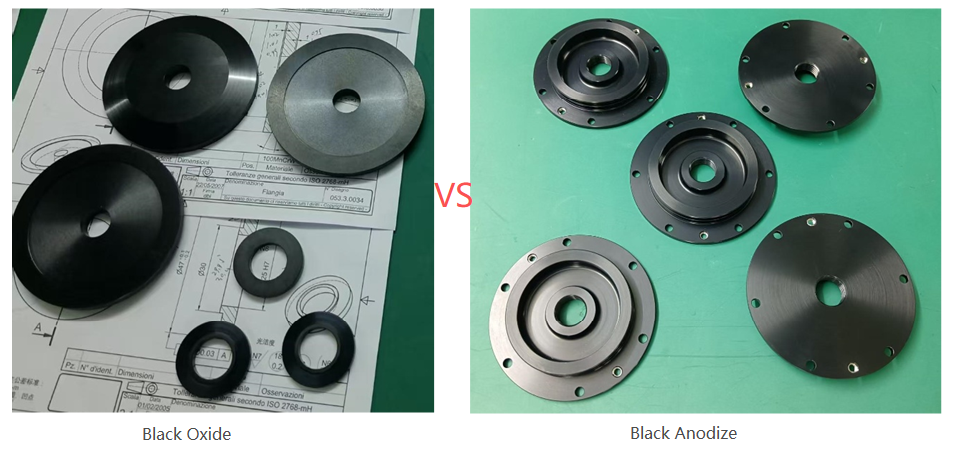
Choosing Between Black Oxide and Anodizing
When deciding whether to choose black oxide or anodizing for your project, it’s important to consider several factors:
- Material: If you’re working with aluminum, anodizing is the clear winner, offering superior corrosion resistance and durability. However, if you’re dealing with steel or brass, black oxide may be the better choice, as anodizing isn’t effective on these materials.
- Corrosion resistance: If the part will be exposed to harsh environments (like saltwater or chemicals), anodizing is the better option. It offers excellent protection against corrosion, especially for aluminum parts.
- Durability and wear: If your part will experience heavy wear and tear, anodizing is more durable due to the thicker oxide layer. Black oxide may wear off more easily over time, especially on parts exposed to friction.
- Aesthetics: Both finishes provide a black finish, but anodizing offers a more customizable range of colors and a more vibrant, long-lasting appearance. If you’re looking for a high-quality black finish with the possibility of additional color options, anodizing may be the way to go.
- Cost: If budget is a primary concern, black oxide is typically more affordable. It is ideal for parts that don’t require extreme durability or high corrosion resistance.
Conclusion: Which Finish is Right for You?
Both black oxide and anodizing offer unique benefits, and the right choice depends on your specific needs. If you’re working with aluminum and need superior corrosion resistance and durability, anodizing is the ideal solution. However, if you’re working with other metals like steel and want a more affordable, simple option, black oxide can still offer a high-quality black finish with moderate protection.
At SYM Machining, we’re committed to helping you select the best finish for your project. Our team has the experience and tools necessary to apply both black oxide and anodizing, ensuring that your parts are finished to the highest standards.
Related articles: