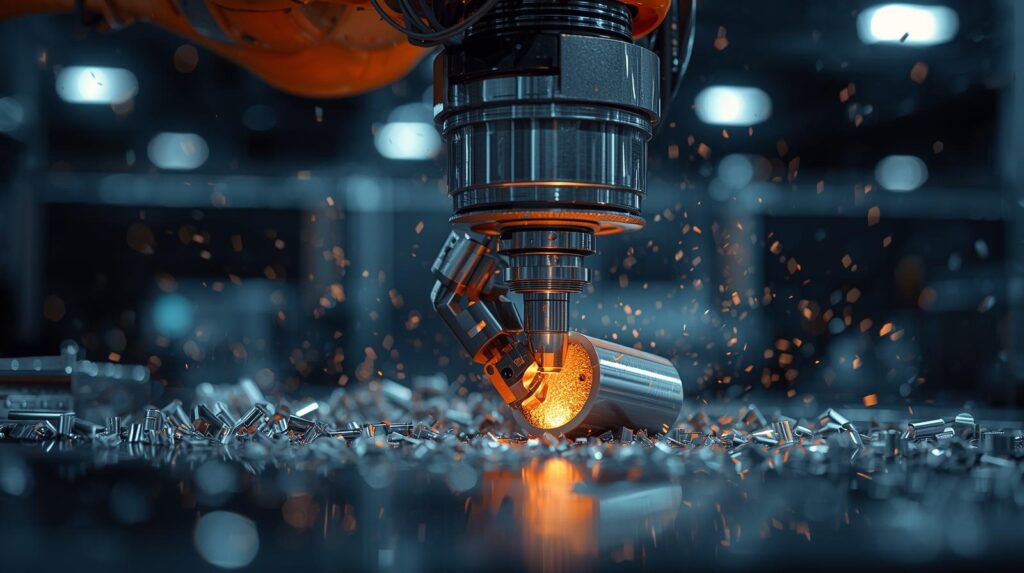
As the name suggests, high-temperature alloys offer greater heat resistance compared to alloy steels. They exhibit reliable stability, high strength, low thermal expansion, and good thermal conductivity in high-temperature environments.
Introduction
High-temperature alloys, also known as superalloys, are engineered to perform under extreme conditions—including high stress, corrosion, and temperatures exceeding 1000°F (538°C). These materials are critical in industries such as aerospace, power generation, and medical technology, where component reliability is non-negotiable. However, machining high-temperature alloys presents significant challenges due to their hardness, low thermal conductivity, and tendency to work-harden.
Overview of High-Temperature & Special Alloys
Definition and classification
Common types:
- Nickel-based superalloys (Inconel, Hastelloy, Waspaloy)
- Titanium alloys (Ti-6Al-4V, Ti-5553, etc.)
- Cobalt-based alloys (Stellite, Haynes)
- Heat-resistant stainless steels (17-4PH, 15-5PH, 13-8Mo)
- Refractory alloys (tungsten, molybdenum, tantalum)
- Properties: strength at high temps, corrosion resistance, hardness, toughness
Machining Challenges of High-Temperature Alloys
- Work hardening tendency
- Poor thermal conductivity → heat concentration at cutting zone
- High cutting forces and tool wear
- Chip control difficulties
- Surface integrity requirements
Main Difficulties in Machining High-Temperature Alloys
1. Rapid Tool Wear
- High cutting forces and concentrated heat lead to flank wear, crater wear, and edge chipping.
- Poor Surface Integrity
- Work hardening and high residual stresses can reduce fatigue life of components.
- Low Material Removal Rate (MRR)
- Cutting speeds are usually much lower than those for steels, reducing productivity.
- Dimensional Accuracy Challenges
- Thermal deformation of both tool and workpiece affects precision.
- Built-Up Edge Formation
- Adhesion between alloy and cutting tool disrupts surface finish.
- High Cutting Forces and Vibration
- Requires rigid machine tools and optimized cutting parameters.
Key Machining Processes for High-Temperature Alloys
Addressing the above difficulties requires adopting optimized machining processes and strategies:
Turning:
- Use lower cutting speeds to control cutting temperature and reduce chemical wear.
- Select a larger feed rate and appropriate depth of cut to ensure the tool cuts below the work-hardened layer, avoiding repeated cutting on the hardened surface.
- The tool rake angle can be appropriately reduced or even negative to increase tool strength, but the issue of increased cutting force must be balanced; the clearance angle should be large enough to reduce friction.
- Ensure the machine tool system has sufficient rigidity and power to avoid vibration.
Milling:
- Conventional milling and climb milling are common. For high-temperature alloys, climb millingis usually recommended because the tool enters the workpiece at the maximum chip thickness, which reduces the contact time between the tool and the work-hardened layer and helps carry heat away with the chips.
- Control impact during tool entry and exit, strategies such as helical or ramped entry can be adopted.
- Different cutting strategies like large depth of cut with small feed, or small depth of cut with large feed, can be combined.
Drilling:
- Drilling is one of the most difficult machining processes for high-temperature alloys due to the confined cutting area, poor heat dissipation, and difficult chip evacuation.
- Specially designed drills are required, such as those with specific flute geometry, high-strength substrates, and heat-resistant coatings.
- Adopt appropriate cutting speeds and feed rates to avoid the formation of built-up edge.
- Forced cooling and chip evacuation are crucial, often requiring internal coolant drills combined with high-pressure cutting fluid.
- Stepped drilling or peck drilling can help break chips and facilitate cooling.
How SYM team find solutions to these problems ?
Pick the right alloy material (and why)
- Ni-base superalloys (cast or wrought): top creep strength to ~1000–1100 °C; great for turbine hot-section. Downsides: density, cost, machining difficulty.
- Co-base & Co-Ni superalloys: better hot corrosion and potential higher-T capability; still developing for cost and supply.
- Fe-base/ODS steels: good oxidation and cost; useful to ~700–800 °C; great for tubes and structural parts.
- Refractory (Nb, Mo, Ta, W alloys): superb at >1100 °C in vacuum/inert; need coatings in air.
- Ti aluminides (γ-TiAl): low density for 700–800 °C rotating parts; brittle, tricky to process.
- Ceramic-matrix composites (SiC/SiC): game-changing weight/temperature tolerance; expensive, different design rules.
Machining & finishing solutions (common pain point)
High-temp alloys are notch-sensitive, work-harden quickly, conduct heat poorly, and abrade tools. Practical tactics:
Tooling:
- Roughing: whisker/SiAlON ceramics or advanced carbides.
- Finishing/hard turning: PCBN or fine-grain carbides.
- Drilling: carbide with TiAlN/TiSiN; through-tool coolant.
- Parameters: lower SFM than steels, maintain constant engagement, use high feed per tooth to stay above work-hardening, avoid dwell.
- Coolant: high-pressure emulsion for chip evacuation; cryo (LN₂ or CO₂) can extend tool life and surface integrity; MQL for certain ops.
- Strategies: trochoidal milling, adaptive toolpaths, pre-drilled corners, entry via ramp/helical, minimize tool overhang.
- Abrasive processes: creep-feed grinding for profiles; use vitrified CBN; control burn and introduce compressive residual stress.
- Deburr/finish: electrochemical machining (ECM), abrasive flow machining (AFM), or isotropic superfinishing for flow paths.
Common “problem → solution” quick matches
- Creep rupture near design life: increase γ′ fraction, shift to DS/SX, reduce mean stress, add internal cooling, or lower metal temperature with better TBC.
- Rapid tool wear & poor surface finish: switch to SiAlON/whisker ceramics for roughing, try cryogenic cooling, increase feed, use adaptive paths; consider ECM/AFM for final finish.
- Hot corrosion in salts/sulfates: apply aluminide + dense MCrAlY; manage contaminants; redesign to reduce stagnation zones.
- AM cracking in Ni superalloys: preheat plate, adjust scan strategy, select AM-friendly chemistry (e.g., IN718 over IN738), then HIP + aging.
- Weld cracking: use low-γ′ fillers, control heat input/interpass, or switch to diffusion bonding/linear friction weld.
Machining Techniques & Strategies
- Conventional machining (turning, milling, drilling, grinding)
- High-speed machining (HSM) conventional
- Cryogenic machining (liquid nitrogen / CO₂ cooling)
- Minimum quantity lubrication (MQL) flood cooling
- Adaptive machining strategies (multi-axis, trochoidal milling)
- Case studies: machining Inconel vs Titanium alloys
Cutting Parameters Optimization
- Feed rate, cutting speed, depth of cut effects
- Heat generation vs removal balance
- Recommended ranges for nickel, titanium, cobalt alloys
- Tool life vs productivity trade-offs
Surface Integrity & Quality Considerations
- Residual stresses
- Surface roughness
- Microstructural changes from heat
- Preventing cracks, burrs, work hardening
Advanced Machining Processes for High-Temp Alloys
- Electrical Discharge Machining (EDM)
- Electrochemical machining (ECM)
- Laser-assisted machining (LAM)
- Ultrasonic vibration-assisted machining
- Hybrid processes
Future Trends in Machining High-Temp & Special Alloys
- AI-driven toolpath optimization
- Advanced cryogenic + hybrid cooling methods
- Sustainable machining (green manufacturing focus)
- Additive + subtractive hybrid manufacturing
Why choose SYM as your long term partner ?
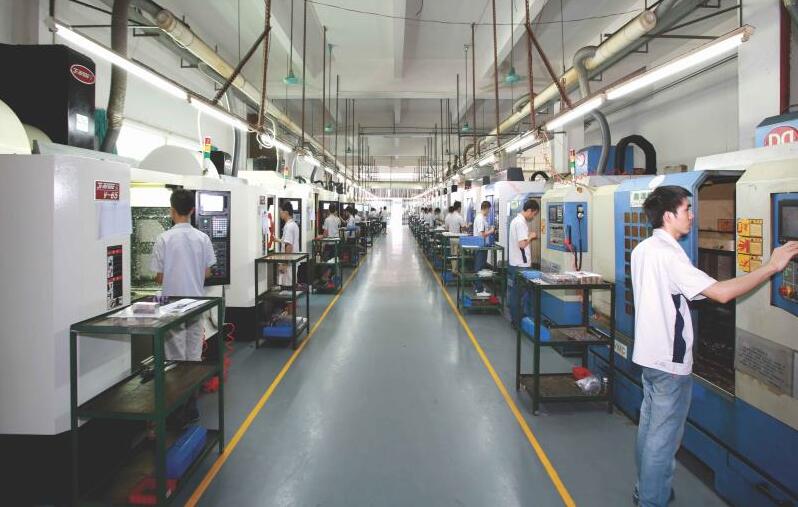
When innovative industries choose to pioneer in the use of new alloys, they reach out to SYM for a very professional outcome: a consistently reliable supply of top-quality machined components.
SYM has a reputation for successfully machining the metals or alloys that other producers prefer not to handle. Customers can confidently design with new materials, secure in the knowledge of high-volume machining that SYM can machine even the most exotic, high-temperature alloys for a quality, cost-effective result.
Conclusion
High temperature alloys prevent a significant challenge in the machining industry. With advancements in material technology, the market share of high temperature,alloys is steadily increasing. It has become crucial to find more efficient and cost effective ways to machine these materials in this session.
By leveraging advanced cutting tools, optimized machining parameters, innovative cooling technologies, and hybrid processes, manufacturers can overcome many of the difficulties. The future trend is moving toward cryogenic machining, adaptive process control, and non-traditional machining methods to further improve efficiency and component performance.
With the development of new materials, new tools, new equipment, and intelligent manufacturing technologies, the ability for efficient and precise machining of high-temperature alloys is continuously improving, providing strong support for the development of key fields such as aerospace and energy.
Related articles:
Expert Guide to Precision Titanium Machining
Anti-Rust Treatment for Carbon Steel Machined Parts