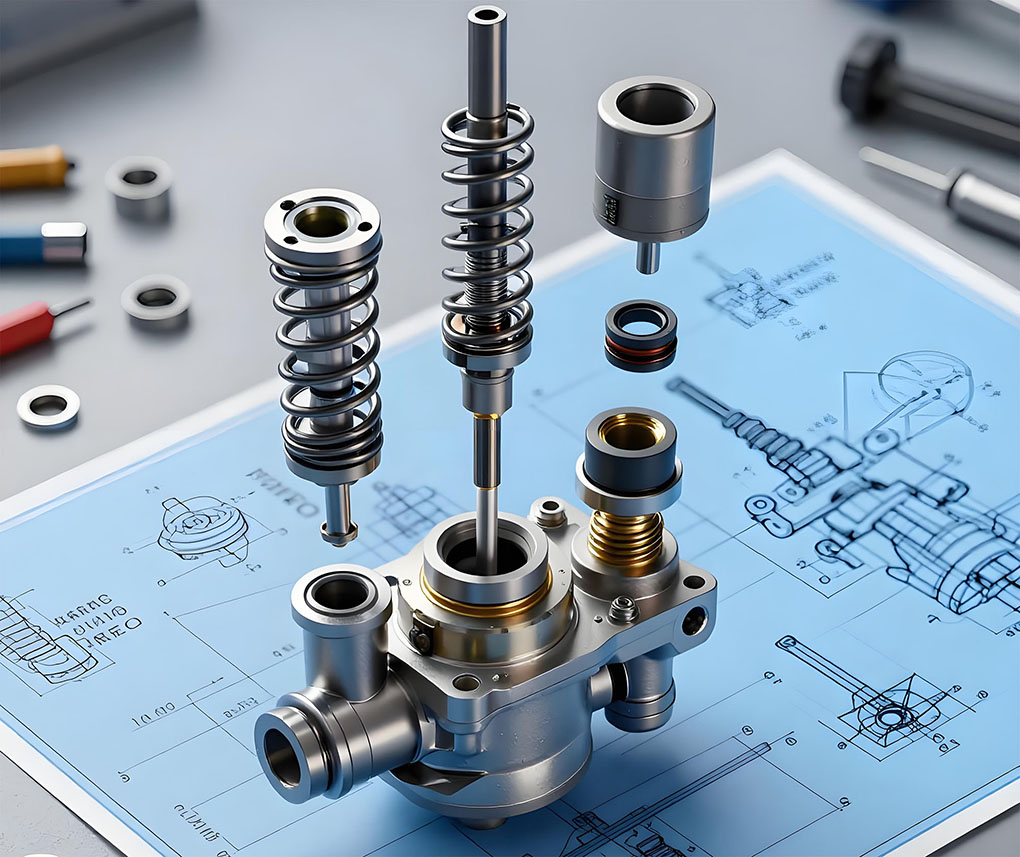
Sourcing Fuel Injection Components? Whether you’re an automotive OEM engineer, a performance shop owner, or a restoration specialist, getting the right parts is critical. Here are 10 tips to guide you:
10 Tips for Sourcing Fuel Injection Components
- Prioritize Tolerances Over Price: Never compromise on specified tolerances for critical sealing and flow dimensions. A part that is slightly cheaper but out-of-spec will cause expensive problems.
- Material Matters: Clearly specify the required material grade (e.g., 6061-T6 aluminum, 304 stainless steel). The material must withstand fuel chemistry, pressure, and under-hood temperatures.
- Demand Certification: For mission-critical parts, require material certifications (mill certs) from your supplier to verify the alloy composition and properties.
- Request First-Article Inspection Reports: Before full production, ask for a detailed inspection report on the first sample part (the “first article”) to verify it meets all print dimensions.
- Understand Surface Finish Requirements: Specify the required surface finish (often in Ra or RMS values) for sealing surfaces. A smoother finish usually seals better.
- Choose a Supplier with Automotive Experience: Not all machine shops understand the rigorous standards of the automotive industry. Select a partner with a proven track record in fuel systems or similar high-precision, high-reliability fields.
- Ask About Their QA Process: Don’t be shy. Ask how they ensure quality. Do they use CMMs? What is their sampling plan for inspection? A reputable supplier will be transparent.
- Consider Lead Time Realistically: High quality machined parts take time. Rushed jobs risk quality. Plan your projects with reasonable lead times that allow for proper manufacturing and inspection.
- Communicate the Application: Tell your supplier how the part will be used. Is it for a street car, a track-only race car, or a vintage restoration? This context helps them advise you on materials and processes.
- Build a Partnership: View your component supplier as a technical partner, not just a vendor. A good partner will offer design-for-manufacturability feedback to improve your part and make it more reliable and cost-effective to produce.

The Future of Fuel Injection Technology and Manufacturing
The evolution of automotive fuel injection components is inextricably linked to the future of the automobile itself.
- Gasoline Direct Injection (GDI) Dominance: GDI, which sprays fuel directly into the combustion chamber at very high pressure (2,000+ PSI), is becoming standard for its efficiency and power benefits. This pushes precision machining to new extremes, requiring components that can handle immense pressures and create ultra-fine, stratified fuel clouds.
- Electrification and Hybridization: Even in hybrid vehicles, efficient internal combustion engines remain crucial. Their fuel injection systems must be even more precise to operate optimally in tandem with electric motors, often using sophisticated Atkinson cycle modes.
- Alternative Fuels: Components for hydrogen internal combustion engines or engines running on sustainable synthetic fuels will need to be customized for different fluid properties and combustion characteristics.
- Additive Manufacturing (3D Printing): While not yet for mass production, 3D printing is revolutionizing prototyping and the creation of ultra-complex, integrated customized components. Imagine a single-piece fuel rail with optimized internal channels for flow that would be impossible to machine traditionally.
- Smart Components: The integration of micro-sensors directly into components (like a fuel rail with a built-in, more accurate pressure transducer) could provide even more data to the ECU for finer control.
Throughout these advancements, the core principles of precision machining, tight tolerance, and a commitment to high quality machined parts will remain the bedrock of performance, safety, and environmental progress.
Automotive Fuel Injection Components
Automotive fuel injection components are the physical executors of the digital command from your car’s computer. They are the critical bridge between software intelligence and mechanical power. This category encompasses a wide array of parts—from the humble fuel filter to the sophisticated high-pressure pump—but they all share a common mandate: to deliver fuel in a precisely controlled manner.
The importance of these components cannot be overstated. They are directly responsible for transforming liquid fuel into usable engine power while minimizing waste and pollution. Their design and manufacturing quality influence your vehicle’s driving character—its throttle response, its smoothness, its fuel gauge’s rate of descent, and the contents of its exhaust pipe. In an era focused on sustainability and efficiency, investing in and understanding automotive fuel injection components is key to advancing transportation technology. They are a prime example of how “small” engineering, focused on micron-level precision, drives “big” outcomes for global mobility and environmental health.
Conclusion
Understanding this interplay between design, material science, and manufacturing excellence empowers us as consumers, enthusiasts, and professionals. On the other hand, it helps us appreciate the engineering in our daily drives, make informed decisions about maintenance and performance. It helps recognize the critical role these small parts play in the larger goals of sustainable mobility as well. The next time you start your car, remember the flawless, high-speed dance of its fuel injection system.
In summary, achieving optimal fuel efficiency, power, and emissions control hinges on flawlessly manufactured components. Partnering with a reliable supplier like SYM Precision Machining—whose core competencies are precision machining, tight tolerance, and a commitment to quality—is a strategic decision for any performance-driven or manufacturing-focused endeavor.