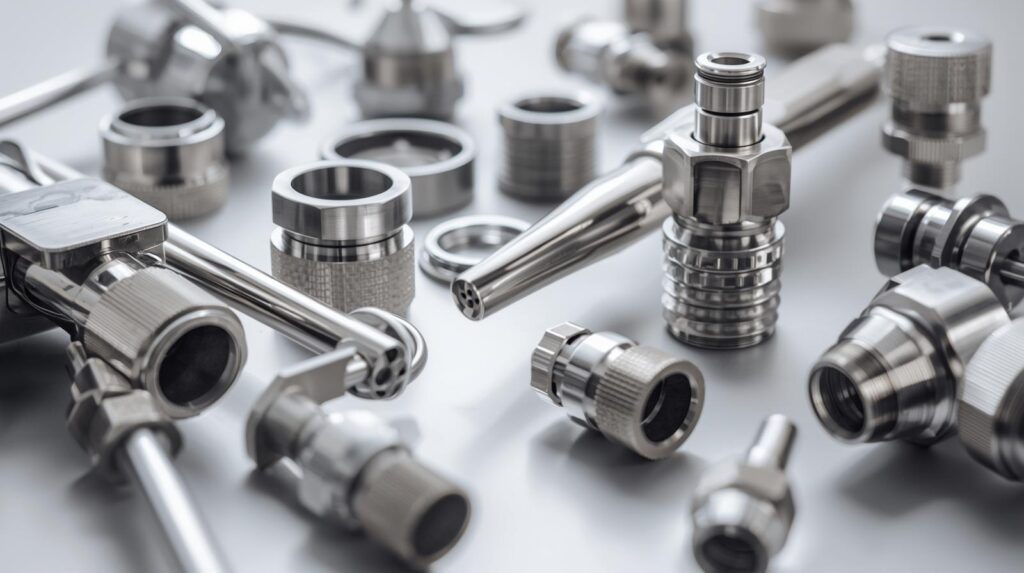
When it comes to medical device manufacturing, material selection is one of the most important decisions engineers and manufacturers face. Among the many options available—titanium, plastics, ceramics, and specialty alloys—stainless steel stands out as the most widely used material for medical device components. Its unique balance of strength, corrosion resistance, biocompatibility, and cost-effectiveness makes it a trusted choice for everything from surgical instruments to orthopedic implants.
Choosing the wrong stainless steel for medical parts can cause failures or safety issues. This leads to costly problems and harms. patient safety. Knowing the right grade ensures reliable, safe medical devices.
let’s dive deeper into the common questions manufacturers and designers like you ask about stainless steel for medical device components.
What kind of stainless steel is used in medical devices?
The most common types of stainless steel used in medical devices are from the austenitic 300 series, specifically 316 and 316L, with 316L being the most prevalent due to its superior corrosion resistance.
Here’s a detailed breakdown of the types, their properties, and applications:
1. 316 / 316L
This is the workhorse of the medical device industry.
Why it’s used: Its excellent corrosion resistance is paramount. The human body is a highly corrosive environment of chloride solutions (salts, bodily fluids). 316L is highly resistant to pitting and crevice corrosion in these conditions.
Key Alloying Elements:
- Chromium (Cr):~17-19% – Forms a passive, protective oxide layer on the surface that prevents rust (corrosion resistance).
- Nickel (Ni):~13-15% – Stabilizes the austenitic structure, providing ductility and formability.
- Molybdenum (Mo):~2-2.5% – Crucially enhances resistance to pitting corrosion, especially from chlorides like saline.
- Low Carbon (L):<0.03% – The “L” stands for “Low Carbon.” This is vital as it prevents carbide precipitation during welding, which can lead to corrosion (sensitization) at the weld points.
Common Applications:
- Surgical Instruments:Scalpel handles, forceps, clamps, needle holders.
- Implants:Bone screws, fracture fixation plates, hip and knee joint replacements (often coated or used for temporary devices), sternal wires, aneurysm clips.
- Medical Equipment:IV poles, surgical tables, instrument trays, cannulas, guidewires.
2. 304 / 304L
This is a general-purpose austenitic stainless steel with good corrosion resistance, but less than 316L.
- Key Difference:It contains molybdenum (Mo), which is the key element that 316L has and 304 lacks. This makes 304 less resistant to chlorides and bodily fluids.
- Applications:Used for non-critical medical devices and equipment that do not see prolonged contact with bodily fluids. Examples include: instrument housings, cabinet panels, storage cabinets, and certain non-implantable components.
3. 440C and 420 (Martensitic Stainless Steels)
These are hardenable grades known for their ability to take and hold a very sharp edge.
- Properties:High strength and excellent wear resistance. They achieve their hardness through heat treatment. Their corrosion resistance is generally lower than that of the 300 series.
- Applications:Primarily used for the cutting edges of surgical instruments like scalpels, blades, and scrapers. 420 is softer than 440C and is often used for lower-cost instruments.
4. 17-4 PH (Precipitation-Hardening Stainless Steel)
This is a versatile grade that can be heat-treated to achieve high strength.
- Properties:Offers a unique combination of high strength (comparable to steel alloys), good corrosion resistance (though not as good as 316L in some environments), and can be machined in a softer condition before being hardened.
Applications: Used for specialized surgical instruments, orthopedic implants (where high strength is needed), and dental devices like drill bits and extractors
Summary Table
| Grade | Type | Key Properties | Common Medical Applications |
| 316 / 316L | Austenitic | Excellent corrosion resistance, formable, biocompatible | Primary choice: Implants (screws, plates), surgical instruments, equipment |
| 304 / 304L | Austenitic | Good corrosion resistance (less than 316L) | Non-critical equipment: Housings, cabinets, trays |
| 440C / 420 | Martensitic | Very high hardness, wear resistance, can hold sharp edge | Cutting edges: Scalpel blades, surgical blades |
| 17-4 PH | Precipitation-Hardening | High strength, good corrosion resistance |
Why Stainless Steel Key Selection Criteria for Medical device components?
Biocompatibility: The material must not elicit an adverse reaction from the body, cause toxicity, or be carcinogenic. The passive oxide layer of stainless steel makes it inherently biocompatible.
Corrosion Resistance: This is the single most important property. Corrosion can lead to device failure and the release of metal ions (Ni, Cr) into the body, which can cause allergic reactions or tissue inflammation.
Sterilizability: The material must withstand repeated sterilization cycles (autoclaving, gamma radiation, chemical sterilants) without degrading or corroding.
Mechanical Properties: The device must have the required strength, hardness, ductility, and fatigue resistance for its function (e.g., a bone plate needs high fatigue strength, while a guidewire needs high ductility).
Formability & Machinability: The alloy must be able to be manufactured into complex shapes (drawn, forged, machined) to create the final device.
Real-Life Examples of Stainless Steel in Medical Device Component
Stainless steel is the workhorse of the medical device industry, prized for its excellent mechanical properties, corrosion resistance, and biocompatibility. Here’s how it’s used in real-world applications.
1. Surgical Instruments (Most common use)
- Components:Scalpels, forceps, clamps, scissors, needle holders, retractors, saws, and drills.
- Why Stainless Steel?It can be sharpened to a fine edge, withstands repeated sterilization (autoclaving) without degrading, and resists corrosion from bodily fluids and cleaning agents.
- Common Grades:410 and 420 for cutting edges (e.g., scalpel blades, scissors). 304 and 316L for instrument bodies and non-cutting parts.
2. Orthopedic Implants and Trauma Devices
- Components:Bone fracture plates, screws, pins, rods, spinal fixation devices, and hip joint replacements (often as a temporary implant or part of a larger system).
- Why Stainless Steel?It provides high strength, fatigue resistance, and rigidity to support healing bones. While titanium is often preferred for permanent implants due to better biocompatibility and modulus matching, stainless steel remains a cost-effective and highly reliable choice for many non-permanent trauma devices.
- Common Grade:316LVM (LVM stands for Ladle Vacuum Melted). This extra-purification process enhances its biocompatibility for internal use.
3. Dental and Orthodontic Applications
- Components:Dental crowns (as a base for porcelain-fused-to-metal crowns), braces, wires, archwires, and endodontic files (for root canals).
- Why Stainless Steel?It is strong, malleable for shaping, and highly resistant to corrosion in the harsh, wet environment of the mouth.
- Common Grades:304 and 316 for brackets and bands. 17-4 PH (Precipitation Hardening) for wires due to its superior springiness and shape memory.
4. Implantable Drug Delivery Devices
- Components:Housings and internal mechanisms of implantable insulin pumps, contraceptive implants, and drug infusion ports.
- Why Stainless Steel?It creates a hermetic (air-tight) and biocompatible seal that protects delicate internal electronics and mechanisms from the body, and the body from the device.
- Common Grade: 316L for its superior corrosion resistance and biocompatibility.
5. Diagnostic and Therapeutic Equipment
- Components:MRI scanner components, radiation therapy frames (e.g., Gamma Knife), hospital beds, IV poles, and surgical tables.
- Why Stainless Steel?It is non-magnetic (specific grades), easy to clean and disinfect, and provides a robust, durable structure. Austenitic grades (e.g., 304) are non-magnetic, which is critical for safety in MRI suites.
- Common Grades:304 and 316 for most applications due to their formability and hygiene.
6. Cannulas and Hypodermic Needles
- Components: The sharp, hollow needle itself.
- Why Stainless Steel? It can be drawn into an extremely thin, sharp, and strong tube that penetrates skin and tissue cleanly without breaking.
- Common Grades: 304 and 420 for their ability to be work-hardened to achieve the necessary strength and sharpness.
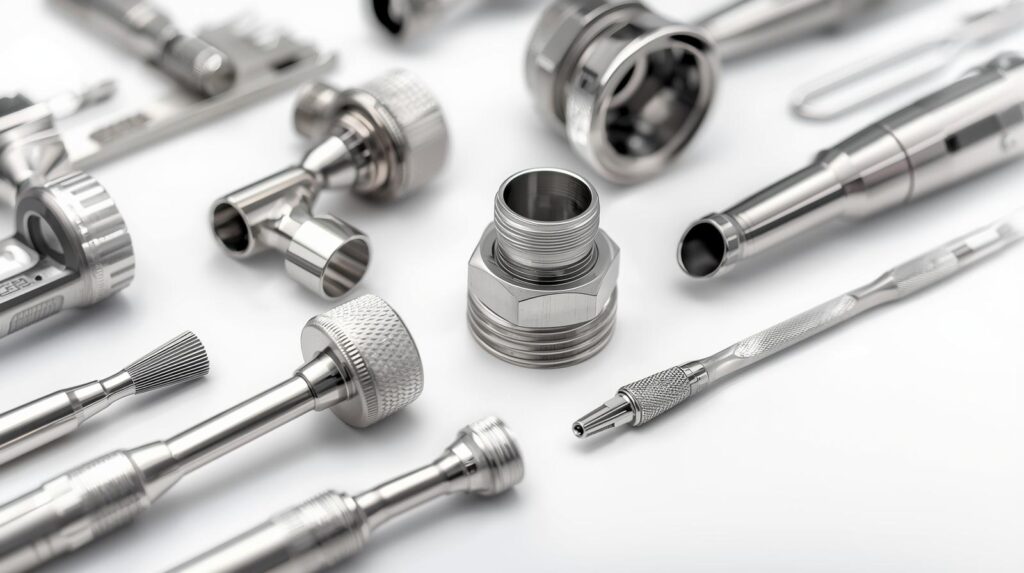
How Stainless Steel Is Made into Medical Devices
The transformation of raw materials into a precision medical component is a multi-stage process that demands extreme precision and rigorous quality control. Here’s a step-by-step breakdown.
Creating the Raw Material – Mill Production
This stage is about creating the specific grade of stainless steel (e.g., 316L, 17-4 PH) in a form that manufacturers can use.
- Melting and Alloying: Raw iron ore, chromium, nickel, molybdenum, and other elements are melted together in an electric arc furnace. The exact ratio is tightly controlled to achieve the desired chemical composition for properties like corrosion resistance and strength.
- Refining for Purity (Key for Medical Grade): For implant-grade materials (like 316LVM), the molten steel undergoes a process called Ladle Vacuum Melting (LVM). This removes impurities and gases (like oxygen and nitrogen), resulting in a more homogeneous, pure, and predictable material—critical for biocompatibility.
- Forming:The molten steel is cast into solid forms like ingots or billets. These are then heated and rolled or drawn into more usable forms:
- Bar Stock:Solid cylindrical bars used for machining.
- Wire:Used for guidewires, orthodontic archwires, and needles.
- Sheet & Plate:Used for laser cutting or pressing into housings, trays, and larger components.
- Tube: Used for catheters, hypotubes, and cannulas
Shaping the Component – Manufacturing Processes
Medical device manufacturers take the raw bar, wire, or sheet and shape it into a specific part.
- CNC Machining: This is the most common method for complex components. A computer-controlled machine uses cutting tools to precisely remove material from a bar or block of stainless steel to create the final shape (e.g., bone screws, orthopedic plates, surgical instrument handles).
- Metal Injection Molding (MIM): Fine stainless steel powder is mixed with a polymer binder and injected into a mold like plastic. The part is then sintered in a furnace, melting away the binder and fusing the metal powder into a solid, high-volume, complex net-shape part (e.g., small gears, jaw components for forceps, connector parts).
- Stamping and Forming: Sheet metal is punched, cut, or bent into shape using dies. This is ideal for high-volume, relatively flat parts (e.g., surgical trays, brackets, razor blades for dermatomes).
- Wire Drawing and Forming: Wire is pulled through progressively smaller dies to achieve ultra-fine diameters. It can then be coiled, straightened, or sharpened (e.g., hypodermic needles, guidewires, stent frameworks).
- Laser Cutting:A high-power laser precisely cuts intricate patterns from sheet metal or tubes. This is essential for creating vascular stents from small tubes.
Finishing – Enhancing Performance and Safety
A raw machined part is not ready for use. Finishing is critical for medical devices.
- Deburring:Removing sharp, microscopic edges and imperfections left from machining.
- Polishing and Grinding:Creating a smooth, mirror-like surface. A smooth surface minimizes areas where bacteria can hide and makes cleaning/sterilization easier. This is vital for surgical instruments and implant surfaces.
- Passivation:This is a critical chemical process. The component is immersed in an acid bath (usually nitric or citric acid). This removes free iron particles from the surface and enhances the natural chromium oxide layer that makes stainless steel “stainless.” It dramatically improves corrosion resistance.
- Electropolishing:An electrochemical process that removes a thin layer of surface material. It results in an ultra-smooth, microscopically clean, and corrosion-resistant surface superior to mechanical polishing. Used for components that contact blood or tissue.
Quality Control and Validation – Ensuring Safety
At every single step, quality is checked and documented.
Material Certification: Mills provide certs proving the material composition meets ASTM standards.
Dimensional Inspection: Using tools like CMMs (Coordinate Measuring Machines) to verify every dimension is perfect.
Surface Inspection: Checking for scratches, pits, or contamination.
Performance Testing: Testing for hardness, tensile strength, and fatigue resistance.
The Critical Role of SYM Machining in Medical Device components manufacturing
1. Precision Engineering and Tight Tolerance Machining
Medical devices often feature incredibly complex geometries that must be produced with micron-level accuracy.
Role of SYM: They utilize state-of-the-art CNC machining centers (including 3-axis, 4-axis, and 5-axis mills and Swiss-style lathes) to machine components from blocks of stainless steel, titanium, and other alloys.
Example: Producing a bone screw with complex threading, a delicate surgical scissors with interlocking jaws, or a minimally invasive surgical instrument component. SYM’s capability to hold tolerances within ±0.001 inches (or even tighter) is essential for ensuring these parts function flawlessly.
2. Expertise in Biocompatible Materials
Not all machining is equal. Machining medical-grade materials requires specific expertise.
Role of SYM: They have deep experience working with grades like:
Stainless Steel 316L and 316LVM: For corrosion resistance.
Titanium (Ti-6Al-4V) and Cobalt-Chromium Alloys: For implantable devices.
Plastics like PEEK and Ultem: For non-metallic components.
Why it matters: Their expertise ensures the material’s integrity is maintained during machining, preventing micro-fractures or surface imperfections that could lead to device failure.
3. Compliance and Regulatory Support (ISO 13485)
The medical industry is heavily regulated. A machine shop must be more than just precise; it must be compliant.
Role of SYM: A key differentiator is their adherence to quality management systems like ISO 13485:2016. This certification proves they have a documented process for design control, traceability, inspection, and corrective action—all critical for FDA approval and other global regulations.
What it provides: Full Device History Records (DHR) and traceability for every batch of components, from raw material lot number to final inspection data.
4. Comprehensive Secondary Operations and Finishing
Machining is only the first step. Finishing processes are crucial for medical device functionality and safety.
Role of SYM: They provide integrated value-added services, including:
Deburring: Removing all sharp edges.
Passivation: A chemical process that enhances stainless steel’s corrosion resistance by restoring its protective oxide layer. This is a non-negotiable step for medical devices.
Electropolishing: Creating an ultra-smooth, microscopically clean, and burr-free surface that is easy to sterilize.
Cleaning and Packaging: Performing precision cleaning to strict cleanliness standards and packaging in controlled environments to prevent contamination.
5. Prototyping and Low-Volume Production
The path from a designer’s CAD model to a market-ready device requires iterative testing.
Role of SYM: They excel at producing functional prototypes and facilitating low-volume production runs. This allows medical device companies to conduct clinical trials, usability testing, and regulatory verification without the high cost of mass-production tooling.
Why Partner with a Specialist Like SYM Machining?
A medical device company partners with a specialist manufacturer like SYM Machining because they provide:
Reduced Time to Market: Their expertise avoids costly mistakes and reworks.
Mitigated Risk: Their compliance and quality systems de-risk the manufacturing process.
Focus: Device companies can focus on R&D and marketing while relying on SYM’s manufacturing excellence.
Conclusion
Stainless steel has earned its reputation as the material of choice for medical device components because it combines durability, biocompatibility, and cost-effectiveness in one package. From life-saving implants to precision surgical tools, stainless steel ensures reliability where it matters most: in the operating room and inside the human body.
At SYM Machining, we specialize in precision machining of stainless steel components for the medical industry, delivering parts that meet strict quality and performance standards. With our expertise, we help medical device manufacturers bring safe, durable, and effective solutions to patients worldwide.
Related articles: