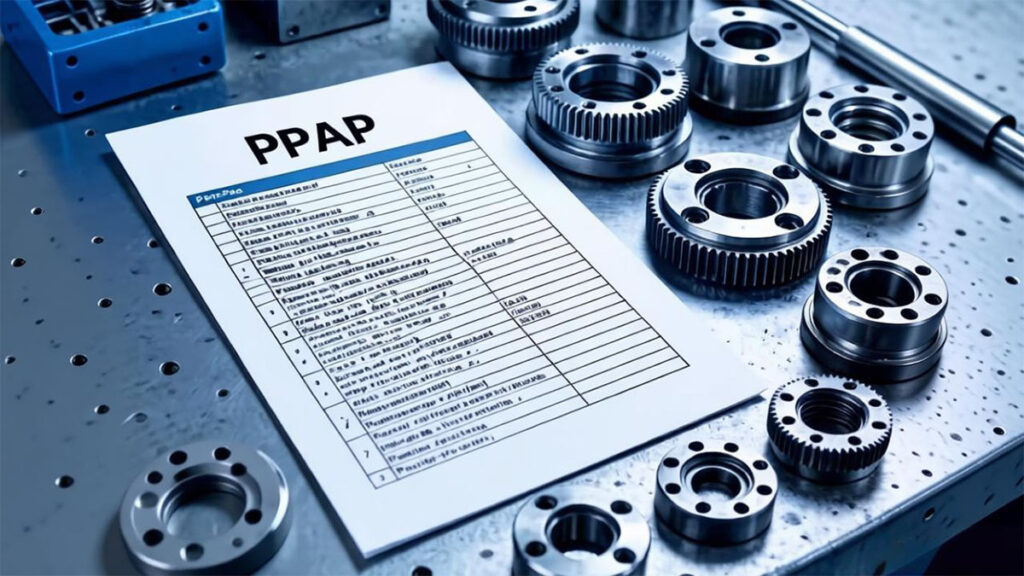
Let’s talk about 18 essential elements of PPAP documentation today.
To achieve approval, a reliable machining supplier must compile a comprehensive package. While the specific requirements can vary by customer, the industry standard (often aligned with AIAG guidelines) requires the supplier to be ready with the following 18 elements . For companies utilizing servizi di lavorazione CNC di precisione, understanding these elements helps you audit your suppliers effectively.
1. Design Record
This is the “source of truth.” It includes all drawings, CAD files, and specifications for the parti lavorate su misura. The supplier must have the correct revision level on file .
2. Authorized Engineering Change Documents
Any changes not yet reflected in the master design record but authorized by the customer must be included
3. Engineering Approval
Where required on the design record, the supplier must obtain customer engineering approval prior to submission .
4. Design Failure Mode and Effects Analysis (DFMEA)
If the supplier is responsible for design, they must conduct a DFMEA. This is an analytical tool used to anticipate potential failure modes in the part design itself .
5. Process Flow Diagram
This illustrates the entire manufacturing journey of your parti lavorate su misura, from raw material receipt to shipping. It must map out each step in the process .
6. Process Failure Mode and Effects Analysis (PFMEA)
While DFMEA looks at the design, PFMEA looks at the manufacturing process. It identifies where the process (e.g., a specific CNC machining operation) could fail and cause quality issues. This is critical for servizi di lavorazione CNC di precisione to anticipate and mitigate risks like tool wear or fixture misalignment .
7. Dimensional Results
The supplier must provide evidence that the parti lavorate su misura conform to all dimensional specifications on the drawing. This usually involves a “full layout” where every characteristic is measured and recorded. For multi-cavity tools or multiple production lines, each must be represented .
8. Material / Performance Test Results
This includes documentation of chemical, physical, or metallurgical properties. If the part requires specific strength or hardness, the test results must be included .
9. Initial Process Study
This is a statistical analysis to determine if the production process is capable of holding the required tolerances. Metrics like Cpk (Process Capability Index) and Ppk (Process Performance Index) are calculated. Generally, a value of 1.33 or higher is required to show the process is capable .
- Cpk ≥ 1.67:The process meets customer requirements.
- 33 ≤ Cpk ≤ 1.67:The process is acceptable but may require improvements or control plan modifications.
- Cpk < 1.33:The process is not capable and requires corrective action.
10. Measurement Systems Analysis (MSA)
The data is only as good as the tools measuring it. MSA studies (such as Gage R&R) evaluate the measurement equipment and techniques to ensure the variation seen in parts is due to the part itself, not the gage .
11. Qualified Laboratory Documentation
If testing was done by an outside lab (e.g., material certification), the lab must be qualified (e.g., ISO 17025). Documentation proving their accreditation must be available .
12. Control Plan
This is a living document that describes the actions required at each phase of the manufacturing process to ensure quality. It links directly to the PFMEA and Process Flow, outlining what will be monitored (e.g., spindle speed, part temperature) and how .
13. Part Submission Warrant (PSW)
This is the cover sheet of the PPAP. The supplier signs this document to warrant that all requirements have been met and the parts represented are from a significant production run (typically 1 to 8 hours of production with a specific minimum quantity, often 300 parts) .
14. Appearance Approval Report (AAR)
For parts with aesthetic or surface appearance requirements, this form documents the approval of the visual characteristics .
15. Sample Production Parts
The supplier must provide actual samples of the parti lavorate su misura taken from the production run. These samples are the physical proof of capability .
16. Master Sample
A master sample is a part retained by the supplier (and sometimes signed by the customer) that serves as a visual or physical standard for comparison during future inspections .
17. Checking Aids
If we used special fixtures, gages, or templates (checking aids) to inspect the part, we must document them. If the customer requires it, we must include these aids in the PPAP or make them available for review.
18. Customer-Specific Requirements
Many OEMs have specific requirements that go beyond the standard PPAP. We must document and adhered to.
Articolo correlato: