In precision manufacturing, some parts look impossible at first glance. The structure may be too complex, the tolerances too tight, or the material behavior too unpredictable. Many suppliers will simply say, “This can’t be made.”
At SYM Machining, we see these challenges differently. We treat them as engineering problems that need solving.
This article shares a real-world case study of a complex machined part that could not be produced using integrated machining. By breaking the problem down, redesigning the manufacturing route, and combining multiple advanced processes, SYM Machining successfully delivered a solution that met all functional, dimensional, and quality requirements.
Understanding the Customer Challenge
The customer approached SYM Machining with a clear request:
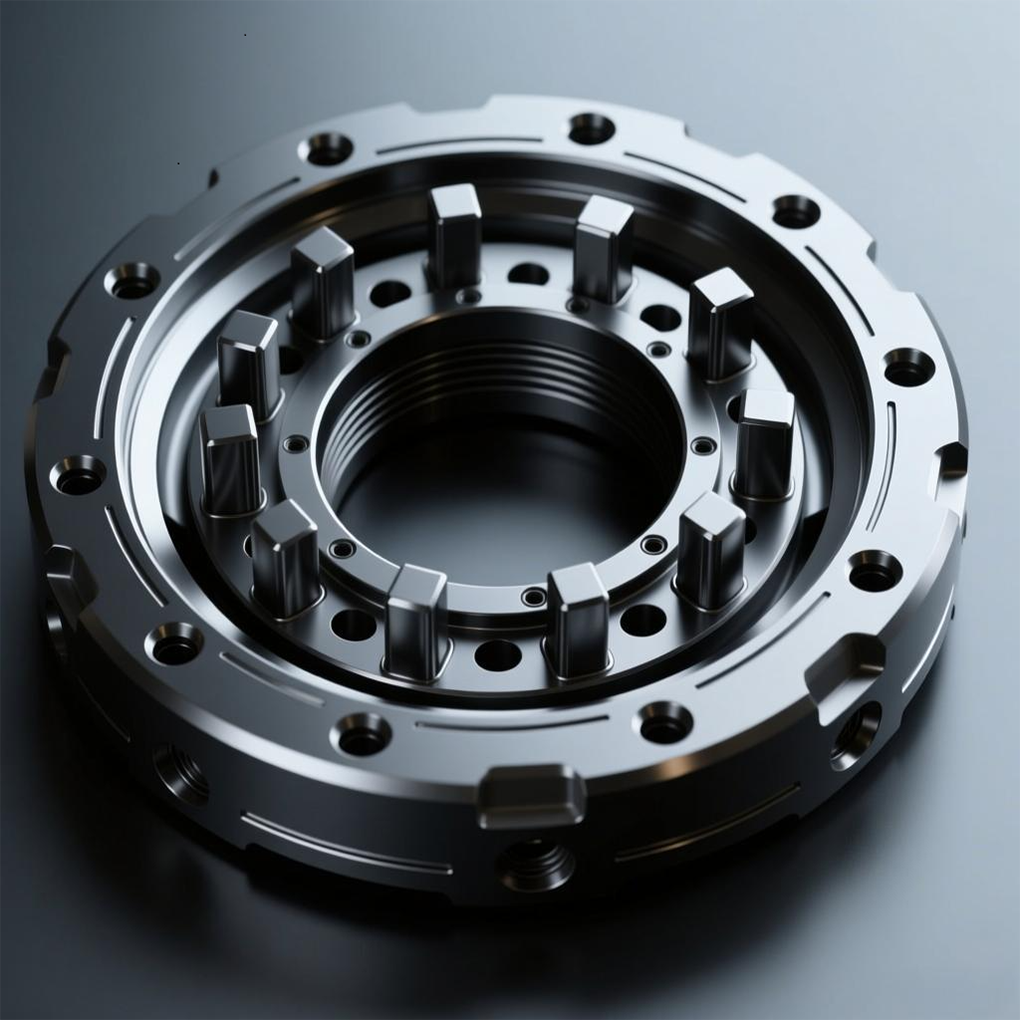
- Produce a high-precision disc component with 20 vertical columns
- Maintain strict dimensional tolerances
- Ensure strong mechanical integrity under load
- Use integrated machining, meaning the part should be machined as one single piece
- Request R 0.5 radius to reduce stress concentrations on these highly loaded pins.
From the technical drawing, this request sounded reasonable. In reality, it presented a major technical conflict.
Why Integrated Machining Failed for This Part
In many complex machining projects, unified (single-piece) processing is often assumed to be the best solution. However, for this component, integrated machining was not feasible—not because of fillet radii at the column roots, and not because the columns were densely arranged, but because of the product structure combined with extremely strict tolerance requirements.
Structural Constraints of the Part Design
This part features a disc with multiple vertical columns formed on a hollow structure. If single-piece processing were forced, each column would need to be machined one by one from top to bottom using CNC milling to remove material.
This method introduces several unavoidable problems:
- Inconsistent column diameters
During step-down milling, tool deflection and vibration cause diameter variation from top to bottom. As a result, the columns cannot maintain uniform cylindrical geometry. - Loss of verticality
Because the columns are long and unsupported, milling forces cause bending. This makes it impossible to guarantee verticality across all columns. - Structural deformation due to hollowness
The hollow structure significantly reduces rigidity. As material is removed, internal stress is released unevenly, leading to part deformation during machining.
Heat Treatment Creates Secondary Deformation
Even if machining accuracy were acceptable before heat treatment, the part would still face secondary deformation after hardening:
- Uneven mass distribution causes distortion during quenching
- Columns shift position or tilt slightly
- Flatness and perpendicularity drift out of tolerance
For high-precision parts, this level of deformation is unacceptable.
Why Integrated Machining Fails Here by Grinding
To meet the drawing specifications, final grinding after heat treatment is mandatory. Grinding is the only process that can reliably achieve:
- Tight dimensional tolerances
- High straightness and roundness
- Stable geometry after heat treatment
However, grinding has clear structural limitations:
Grinding can only be applied to:
- Flat surfaces
- Individual cylindrical components
Grinding cannot be effectively applied to:
- Multiple columns connected to a base
- Complex integrated structures with obstructed tool access
Because of this, the part structure cannot be completed through integrated machining followed by grinding.
Integrated Machining Is Structurally Impossible
In summary, integrated machining failed for the following reasons:
- The hollow structure lacks sufficient rigidity during CNC milling
- Column diameters cannot remain consistent when machined top-down
- Verticality cannot be guaranteed due to deformation
- Heat treatment introduces unavoidable secondary distortion
- Final grinding—required for tolerance control—cannot be applied to the integrated structure
Therefore, the product structure and tolerance requirements make integrated machining technically impossible.
Why a Multi-Process Solution Was the Only Viable Path
To achieve the precision specified in the drawing, the part had to be:
- Machined as separate components
- Heat-treated and ground individually
- Assembled using interference fitting and laser welding
- Finished with final surface grinding for flatness and appearance
This process-driven approach ensured accuracy, stability, and repeatability—something integrated machining could not deliver.
Instead of forcing an unworkable method, SYM Machining proposed a multi-step, separated processing strategy that guaranteed performance and reliability.
The SYM Machining Engineering Solution
Rather than asking the customer to redesign the product, we redesigned the manufacturing process.
Our solution combined turning, heat treatment, grinding, interference fitting, laser welding, and precision finishing—all tightly controlled.
1. Precision Machining of the Disc and Columns
The disc and 20 individual columns were manufactured separately:
- CNC turning
- Controlled hardening
- Precision grinding
Each column was machined to meet strict drawing specifications, including:
- Diameter tolerance
- Straightness
- Surface finish
Why this mattered:
By separating the components, we eliminated deformation risks during heat treatment and ensured consistent quality for every column.
2. Interference Fit Assembly
Each of the 20 columns was pressed into the disc using an interference fit
- Press-fit parameters were precisely calculated to ensure:
- High retention force
- No cracking or stress concentration
- Accurate vertical alignment
Result:
The columns were mechanically locked into the disc and could not loosen during operation.
3. Laser Welding Reinforcement
To further enhance structural integrity, Laser welding the bottom surface of the disc.
Using a vertical alignment welding fixture to:
- Maintain precise column position
- Control heat input
- Avoid distortion
Laser welding provided additional strength without compromising dimensional accuracy.
4. Final Grinding and Surface Finishing
The bottom surface of the disc was precision ground:
- Removed protruding weld material
- Ensured full flatness
- Delivered a clean, high-quality appearance
Final result:
A flat, smooth bottom surface that met both functional and aesthetic requirements.
5. Quality Control at Every Stage
Throughout the entire process, SYM Machining applied strict quality controls:
- Dimensional inspection after each major step
- Runout and flatness checks after grinding
- Assembly verification for column alignment
- Final visual and functional inspection
This approach ensured repeatability, reliability, and full compliance with the customer’s drawing.
6. The Final Outcome
Despite initial doubts that can make the part, SYM Machining delivered:
- A fully compliant complex assembly
- Excellent structural strength
- Stable geometry after heat treatment and welding
- High-quality surface finish
Most importantly, the customer gained confidence that even manufacturing “impossible” parts with the right engineering mindset.
Why This Case Matters for Complex Machined Parts
This project highlights a critical lesson in modern CNC machining. integrated machining is not always the best solution. Successful manufacturing of complex parts often depends on engineering the process rather than forcing a single machining method. This means first breaking the assembly into logical subcomponents based on function and tolerance, then selecting the most suitable manufacturing process for each individual feature.
Precision is further ensured by combining CNC machining with advanced joining technologies, such as interference fitting and laser welding, to achieve structural integrity without compromising accuracy. Together, this process-driven approach helps manufacturers meet demanding specifications that part geometry alone cannot meet.
Looking for a Solution to a Difficult Machining Challenge?
If you design a part that is impossible to make, requires multiple processes, or falls outside standard manufacturing capabilities, SYM Machining is ready to help. Contact our engineering team to discuss your next complex project—and discover what is truly possible with the right manufacturing partner.