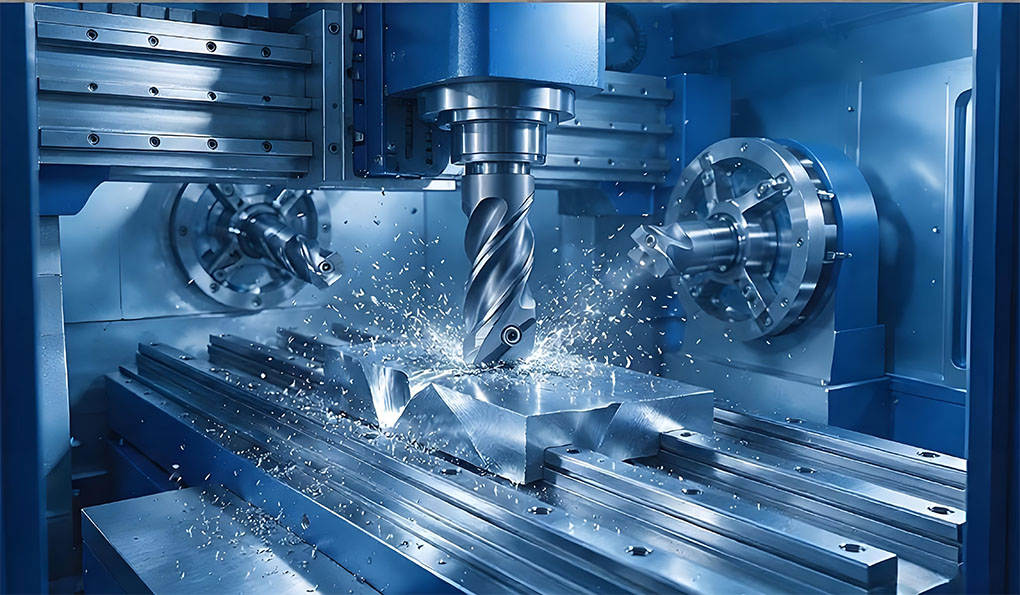
Modern manufacturing demands tighter tolerances, complex geometries, and faster production cycles. Industries from aerospace to medical technology keep pushing the boundaries of what machines can produce. At the center of this revolution sits multi-axis CNC milling.
This guide explores multi-axis machining in depth. You will learn how it works, where it excels, where it falls short, and why it has become the gold standard for producing precision machined parts. Engineers, procurement specialists, and anyone seeking reliable custom metal work will find practical value here.
What Is Multi-Axis CNC Milling?
CNC milling uses rotating cutting tools to remove material from a workpiece. The most basic setup, 3-axis machining, moves the tool along three linear axes: X (left-right), Y (forward-backward), and Z (up-down).
Multi-axis CNC milling adds one or more rotational axes. These extra axes let the cutting tool or the workpiece rotate. The machine can then approach the material from almost any angle.
The term “multi-axis” covers 4-axis, 5-axis, and even more complex systems. The 5-axis configuration dominates modern manufacturing. A 5-axis machine combines the three linear axes with two rotational axes (typically A and B, or B and C). This setup allows continuous adjustment of the tool’s orientation relative to the workpiece.
How Multi-Axis Machining Works
The real power of multi-axis machining comes from controlling the relationship between tool and material. A 3-axis machine keeps the tool’s orientation fixed. A hole on a different face requires the operator to stop, reposition the workpiece, and restart.
A multi-axis setup tilts and rotates the part or the tool head to reach those features without manual intervention. Shops use two primary approaches.
Indexed Mecanizado en 5 ejes (3+2 Axis)
Indexed machining offers the most practical entry point for shops moving to advanced machining. The two rotational axes position the workpiece at a specific angle. The machine then locks the workpiece in place and machines with the three linear axes.
This approach allows machining of five sides of a part in a single setup. The part moves far fewer times, which saves time and protects accuracy.
Simultaneous 5-Axis Machining
Simultaneous machining represents the pinnacle of CNC technology. All five axes move at the same time. The cutting tool continuously changes orientation as it travels along the toolpath.
Complex contoured surfaces demand this capability. Turbine blades, impellers, and medical implants all fall into this category. The machine uses the side of the cutting tool rather than just the tip. The result: a smoother surface finish and longer tool life.
Advantages and Disadvantages of Multi-Axis Machining
Every manufacturing decision involves trade-offs. Multi-axis machining delivers remarkable benefits, but it also carries real costs and constraints. The table below summarizes the key strengths and weaknesses.
| Ventajas | Impact Level | Disadvantages | Impact Level |
| Single-setup efficiency | Muy alta | High equipment cost | Muy alta |
| Superior accuracy and tolerance | Muy alta | Programming complexity | Alta |
| Complex geometries and undercuts | Muy alta | Skilled operator requirements | Alta |
| Improved surface finish | Alta | Maintenance and downtime costs | Moderado |
| Extended tool life | Alta | Setup time for simple parts | Alta |
| Reducción de los costes laborales | Alta | Limited part size capacity | Moderado |
| Part consolidation | Muy alta | Training investment | Alta |
| Reduced fixturing costs | Alta | Software and post-processor costs | Moderado |
The table reveals an important truth. Multi-axis machining shines brightest when part complexity runs high and production volumes justify the investment. Simple parts with loose tolerances rarely benefit from the technology.
The Major Advantages Explained
Single-Setup Efficiency
Setup reduction stands as the most tangible benefit. Every time a part moves between machines or gets repositioned in a fixture, alignment errors creep in. Multi-axis machines complete complex geometries in one setup, or at most two. This approach eliminates the “stack-up” of errors that accumulates across multiple moves. Labor costs and lead times drop accordingly.
Superior Accuracy and Tolerance
Holding a part in a single position while accessing multiple sides improves relative accuracy between features. Modern 5-axis machines hold tolerances that 3-axis machines struggle to match across multiple operations. Aerospace and medical industries cannot compromise on this level of precision. A deviation of a few microns can prove catastrophic.
Complex Geometries and Undercuts
Multi-axis machining frees engineers from the “design for manufacture” constraints of the 3-axis era. Organic free-form surfaces, deep undercuts, and angled features become achievable. These geometries previously required assembly from multiple components. Part consolidation reduces individual components, fasteners, and potential failure points.
Improved Surface Finish and Tool Life
Simultaneous 5-axis machining maintains the optimal cutting angle relative to the part surface. Manufacturers use shorter, more rigid cutting tools and engage material with the side of the tool rather than the tip. Tool deflection and vibration decrease. Surface finish improves, often eliminating secondary hand-polishing operations.
Reduced Labor and Fixturing Costs
Fewer setups translate directly to fewer labor hours. Complex fixturing that holds a part at odd angles for 3-axis machining becomes unnecessary. The machine’s rotational axes handle positioning instead. Shops save on fixture design, fabrication, and maintenance.
The Notable Disadvantages Explained
High Equipment Cost
Multi-axis CNC machines cost significantly more than their 3-axis counterparts. A quality 5-axis machining center can run two to five times the price of a comparable 3-axis machine. This capital investment requires careful justification through part complexity and production volume.
Programming Complexity
Multi-axis toolpaths demand sophisticated CAM software and skilled programmers. Collision avoidance, tool orientation, and post-processor development add layers of complexity. Programming time for a 5-axis part often exceeds that of a 3-axis part by a considerable margin.
Skilled Operator Requirements
Running a multi-axis machine requires training beyond basic CNC operation. Operators must understand spatial relationships, tool dynamics, and machine kinematics. Finding and retaining skilled talent presents an ongoing challenge for many shops.
Maintenance and Downtime Costs
More axes mean more motors, bearings, and control systems that can fail. Maintenance schedules grow more complex. When a multi-axis machine goes down, the impact on production can be severe, especially if the shop lacks redundant capacity.
Setup Time for Simple Parts
Multi-axis machines offer little advantage for simple parts. The setup and programming overhead can actually make them slower than 3-axis machines for straightforward work. Shops must match the machine to the job.
Limited Part Size Capacity
Many 5-axis machines, particularly trunnion-style configurations, have size limitations. Large parts may not fit within the machine’s work envelope. Swivel head configurations address this issue but come with their own trade-offs.
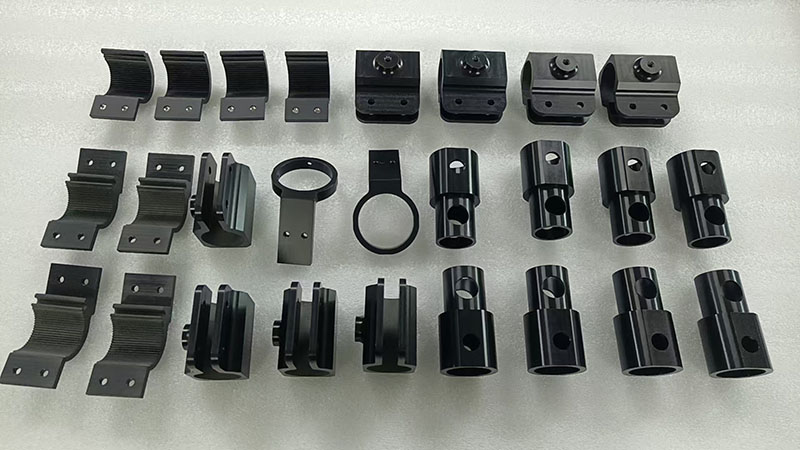
Industries That Rely on Multi-Axis Machining
Aeroespacial y defensa
Aerospace leads adoption of multi-axis technology. Turbine blades, structural formers, and engine parts require complex geometries and stringent tolerances. These components must perform reliably in extreme environments. Multi-axis machines produce these parts from difficult materials like titanium and Inconel. The technology ensures structural integrity and aerodynamic efficiency.
Medical Technology
Orthopedic implants and surgical instruments demand perfection. Multi-axis machining creates patient-specific implants with porous structures that mimic human bone. It also produces intricate surgical tools that fit comfortably in a surgeon’s hand. Smooth, contoured surfaces and complex internal channels prove vital for device functionality and safety.
Automotive and Motorsports
Performance drives everything in automotive and motorsports. Multi-axis machining produces engine components, transmission cases, and custom parts for high-performance vehicles. Rapid prototyping and production of complex components reduce weight without compromising strength. Fuel efficiency and speed both improve.
Tool and Die Making
Molds and dies for injection molding and die casting feature complex three-dimensional shapes. Multi-axis machining cuts deep cavities and intricate details with the required surface finish. Machining precision directly translates to final molded product quality.
Types of Multi-Axis CNC Milling Machines
4-Axis Machining
A 4-axis machine adds one rotational axis (usually the A-axis, rotating around X) to the standard three. Shops use this configuration for cylindrical parts like shafts with complex features. It also handles drilling holes at different angles around a part’s circumference. This represents a significant step up from 3-axis but lacks full 5-axis flexibility.
Mecanizado en 5 ejes
Five-axis systems add two rotational axes. Several common configurations exist:
Trunnion Style: The workpiece sits on a trunnion table that tilts (A-axis) and rotates (C-axis). This design suits vertical machining centers and works well for smaller, complex parts.
Swivel Head Style: The spindle mounts on a head that swivels and tilts. The table remains stationary or moves in X and Y. This configuration handles large parts, such as those in aerospace.
6-Axis and Beyond
Specialized machines, often gantry style, feature up to 6 or more axes. Very large, complex parts benefit from maximum flexibility. A 6-axis machine might combine a milling head with three rotational axes on a gantry structure with three linear axes.
The Future of Multi-Axis Machining
Multi-axis machining is moving toward greater integration and automation. “Lights-out” manufacturing allows multi-axis machines to run unattended for hours or even days. IoT sensors and real-time data analytics monitor spindle health, tool wear, and thermal stability. Maintenance needs get predicted before downtime occurs.
The line between additive and subtractive manufacturing is also blurring. Some advanced multi-axis machines now feature hybrid capabilities. They deposit material (3D print) and then machine it to exact tolerances in a single setup.
Artificial intelligence is entering the picture as well. AI-driven toolpath optimization reduces programming time and improves cutting efficiency. Machine learning algorithms analyze historical data to predict optimal feeds and speeds for new materials.
Conclusion: The Competitive Edge of Multi-Axis Milling
Multi-axis CNC milling is more than a manufacturing process. As a competitive advantage, it empowers engineers to design bolder, more efficient products while enabling manufacturers to produce them with unprecedented accuracy and speed.
The advantages clearly outweigh the disadvantages for complex, high-value parts. Single-setup efficiency, superior accuracy, and complex geometry capability deliver results that 3-axis machining cannot match. The disadvantages, while real, diminish as production volume and part complexity increase.
For anyone involved in procurement or design of custom metal work, understanding multi-axis machining capabilities is essential. By leveraging simultaneous and indexed machining, businesses achieve the geometric complexity and surface finishes required for demanding applications. As the technology evolves and becomes more accessible, it will remain a cornerstone of innovation in precision machined parts for decades to come.
Whether you build the next generation of aircraft, life-saving medical devices, or high-performance automotive components, multi-axis milling provides the foundation for excellence. The investment pays dividends through quality, speed, and capabilities that set your products apart.
Artículos relacionados: