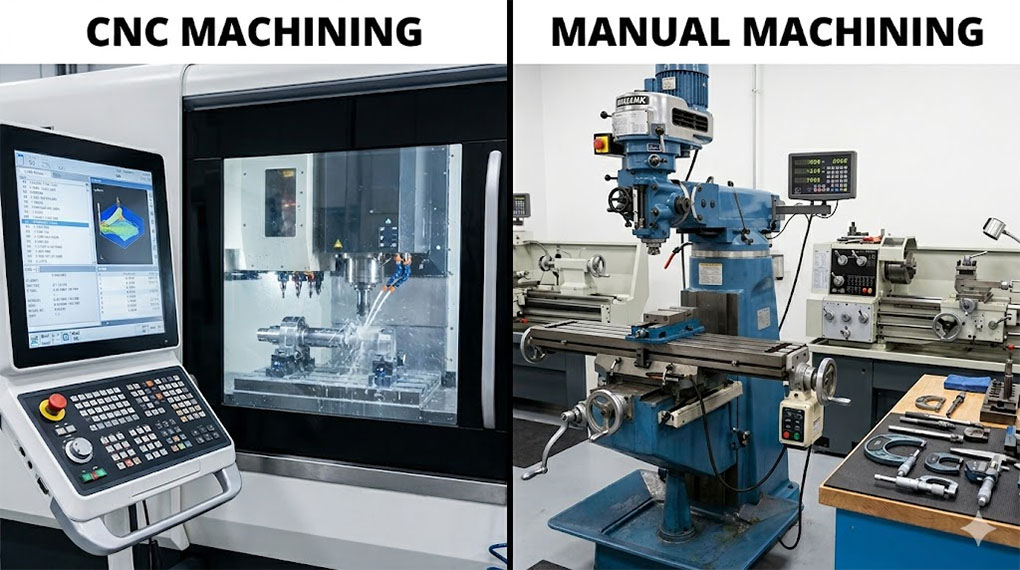
The manufacturing landscape has undergone a dramatic transformation over the last few decades, shifting from manual craftsmanship to digital, automated precision. At the heart of this evolution lies a fundamental debate that every product developer, engineer, and procurement manager faces: CNC Machining vs. Manuelle Bearbeitung. To begin with, turning handles and adjusting levers holds a revered place. In particular, this is true in industrial history and specialized toolrooms. However, modern commercial demands require a different level. As a result, they require more operational velocity and precision.
Understanding the structural differences between these two methodologies is no longer just an academic exercise—it is a core business strategy. If your enterprise is still heavily reliant on conventional machining workflows for production volumes, you are likely absorbing hidden financial drains, longer lead times, and structural bottlenecks.
Transitioning from operator-dependent machinery to Computer Numerical Control (CNC) systems represents the single most impactful technological upgrade a manufacturer can make. Here are the 5 definitive, deeply analytical reasons why automating your production lifecycle via advanced CNC machining is a critical mandate for modern commercial survival.
Dimensional Repeatability and Flawless Structural Consistency
Manual machining relies completely on the physical coordination, visual acuity, and muscle memory of a human operator. Even the most elite master machinists, with decades of chip-making experience under their belts, are subject to physical fatigue, ambient environmental distractions, and subtle sensory variances. When a manual operator turns a handwheel to cut a precise radius, micro-variations inevitably occur from the first workpiece to the fiftieth. In high-stakes industries like aerospace, medical device manufacturing, and defense engineering, these microscopic variations lead to catastrophic part failures and unacceptable scrap rates.
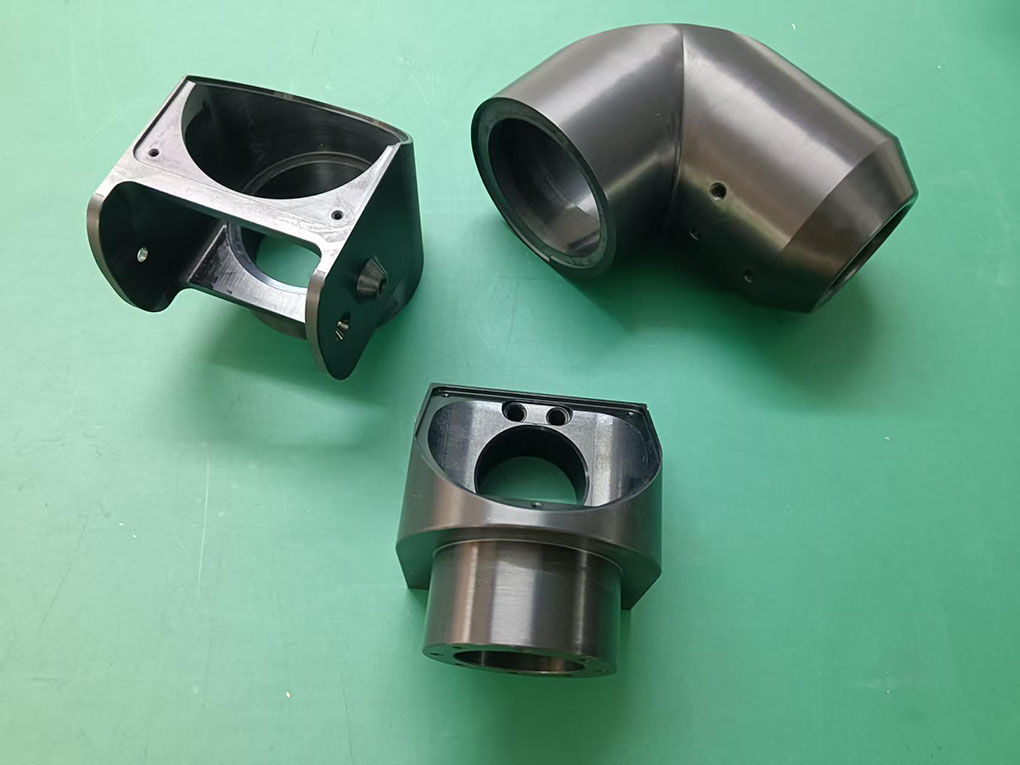
Automating with CNC technology completely decouples dimensional accuracy from human fallibility. A CNC machine operates on a closed-loop system governed by rigid G-code and M-code programming directives, translating digital computer-aided design (CAD) models into exact physical kinetic actions. The machine’s physical axes are driven by high-torque servomotors and precise ball screws that measure displacement down to single-micron increments.
Because the toolpath is mathematically locked into the computer’s memory, the machine executes the exact same cut, at the exact same feed rate, across thousands of consecutive production cycles. This absolute structural consistency eliminates the standard bell curve of dimensional drift, giving your assembly lines components that fit together flawlessly every single time, without the need for manual deburring or secondary adjustments on the assembly floor.
Multi-Axis Geometric Complexity Beyond Human Capability
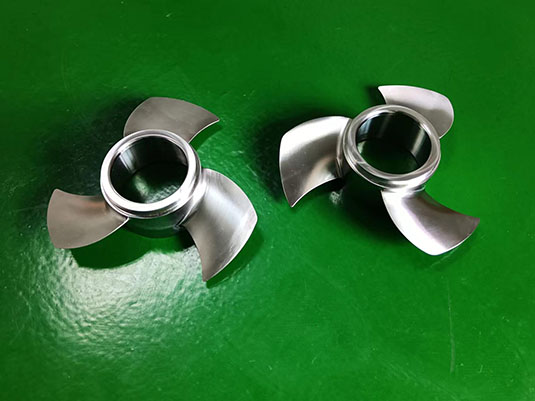
The structural architecture of conventional, manual machine tools natively restricts operations to orthogonal planes. A standard manual mill or lathe requires an operator to manually fixture. Such as a raw metal block, execute a linear or rotational cut along the X or Y axis. Next, stop the machine, physically re-index the part, and set up the next operational profile. Attempting to machine intricate geometries. Such as compound curves, complex internal undercuts, helical turbine blades, or organic anatomical contours on a manual machine. This is mathematically and structurally impossible without constructing highly complex, proprietary custom fixtures that require days to build and validate.
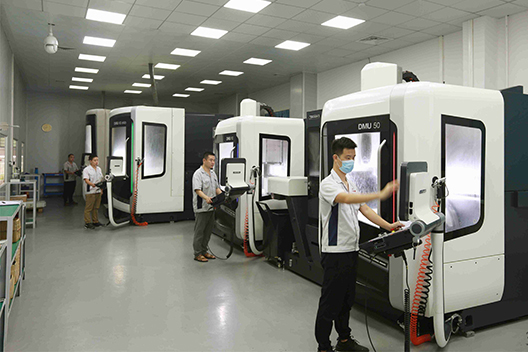
CNC automation unlocks geometric freedom by integrating multi-axis sync capabilities. Advanced 3-axis, 4-axis, and continuous 5-axis CNC machining centers can manipulate the cutting tool and the raw workpiece simultaneously across multiple linear and rotational planes. This capability allows the cutting tool to maintain an optimal perpendicular orientation to complex, sweeping surfaces, sculpting highly intricate monolithic geometries out of solid aerospace-grade billets in a single, continuous setup.
By eliminating the need for multiple manual refixturing setups, automation removes the compounding stack-up errors that occur every time a human hand repositions a part. If your product designs require lightweighting, optimized internal fluid dynamics, or highly sophisticated aesthetic silhouettes, manual machining acts as a restrictive design anchor, whereas CNC automation lets your engineering team design for pure functional performance.
Exponentially Accelerated Throughput and Cycle Time Optimization
In conventional manual machining, production speed is tightly governed by human limitations and safety thresholds. An operator must constantly monitor the cutting zone, manually adjust coolant hoses, check dimensional tolerances with vernier calipers between passes, and conservative feed rates must be maintained to prevent sudden tool breakage or physical injury. The spindle spends a massive portion of the operational day completely stationary while the operator reviews blueprints, switches out manual tool holders, or cranks tables back to their home coordinates. This stop-and-go workflow results in incredibly low machine utilization rates and prolonged lead times.
| Operational Vector | Manual Machining Systems | Automated CNC Ecosystems |
| Primary Kinematic Control | Human physical handwheels & manual levers | Closed-loop digital servo & ball screw drives |
| Geometric Capacity | Simple orthogonal planes & basic linear profiles | Complex continuous 5-axis monolithic sculpting |
| Spindle Utilization | Low (interrupted by manual checks & tool changes) | High (continuous operation with active cooling) |
| Tooling Transitions | Manual wrench adjustments & physical indexing | High-speed automated carousel tool changers |
By contrast, automated CNC platforms are engineered for relentlessly continuous, high-velocity material removal. Armed with high-speed automated tool changers (ATCs), a CNC mill can transition from a heavy roughing indexable face mill to a micro-diameter carving drill in less than two seconds, without interrupting the production rhythm. Advanced adaptive clearing algorithms programmed via CAM software optimize the tool’s engagement angle, allowing the machine to run at maximum spindle speeds and aggressive feed rates that would instantly terrify a manual operator.
Furthermore, automation enables true “lights-out” manufacturing. With pallet changers, bar feeders, and integrated robotic loaders, a CNC production cell can continuously process raw metal into finished, high-tolerance components overnight with zero human supervision, transforming your production schedules from weeks into mere hours.
Drastic Optimization of Labor Overhead and Bottom-Line Operational Costs
Running a competitive manufacturing business on manual infrastructure creates an expensive, unscalable labor model. On a manual shop floor, the scaling ratio is strictly one-to-one: one machine requires one highly paid, skilled machinist to stand before it at all times. Suppose you need to scale up output quickly due to a sudden surge in orders. In that case, your only choice is hiring more specialized technicians. However, these technicians come from a dwindling, increasingly expensive labor pool. Alternatively, you could pay astronomical overtime premiums. Unfortunately, those premiums will quickly erode your project profit margins.
Automating your machining operations totally re-engineers this financial equation. While CNC machining still requires human intellect for initial programming, setup configuration, and quality assurance, a single technician can seamlessly oversee a multi-machine cell of three, four, or five running CNC centers concurrently. The human asset transitions from a manual lever-puller to a high-level systems optimizer.
This dramatic shift significantly drops the direct labor cost absorbed by each individual machined component. Additionally, because CNC systems systematically eliminate human error, your raw material waste, scrap expenses, and tool breakage costs plummet toward zero. The capital invested in CNC automation rapidly pays for itself by compressing variable operational overhead and unlocking substantial, predictable gross margins.
Future-Proof Digital Supply Chain Integration and Agility
Manual manufacturing is an analog island in an increasingly interconnected, digital industrial universe. Manual manufacturing leaves no digital process footprint. Specifically, quality tracking relies on paper logs, while machine uptime metrics are non-existent. Moreover, duplicating a part requires reverse-engineering a physical sample oder interpreting old shop notes. Because of this, your production floor becomes isolated from modern ERP systems. Ultimately, you cannot participate in agile supply chain frameworks.
Automating via CNC embeds your manufacturing operations directly into a modern digital thread. Manual manufacturing leaves no digital process footprint. Specifically, quality tracking depends on paper logs, while machine uptime metrics remain nonexistent. Moreover, duplicating a part means reverse-engineering a physical sample or deciphering old shop notes. Because of this, your production floor becomes isolated from modern ERP systems. Ultimately, you cannot participate in agile supply chain frameworks.
Furthermore, modern CNC machinery compiles continuous diagnostic data, providing real-time telemetry regarding spindle loads, thermal expansion, and tool wear. This rich digital connectivity enables predictive maintenance schedules. It also allows for instantaneous engineering changes. As a result, your business gains operational agility. Consequently, you can pivot production strategies instantly whenever market demands shift.
Conclusion: The Strategic Path Forward
Choosing between manual execution and CNC automation is ultimately a choice between stagnation and growth. Manual machining will always be essential for quick repairs, basic prototyping, or simple single-unit brackets. However, it can no longer support a competitive, scaling commercial enterprise. Transitioning to automated CNC infrastructure guarantees unmatched dimensional repeatability. It also enables complex multi-axis geometric execution, maximizes throughput, reduces labor liabilities, and integrates seamlessly into the modern digital supply chain.
Continuing to postpone automation gives competitors space. They can out-price, out-produce, and out-maneuver you. Are you ready to elevate your product quality? Do you want to compress manufacturing lead times? You can leverage elite precision engineering, backed by advanced automated technology. Unlock the competitive edge your designs deserve. Partner with SYM-Bearbeitung for your custom component production needs.
If you have needs for machining parts projects. Send us your drawings for engineering review. SYM Machining always your trustworthy choice.
Verwandte Artikel: