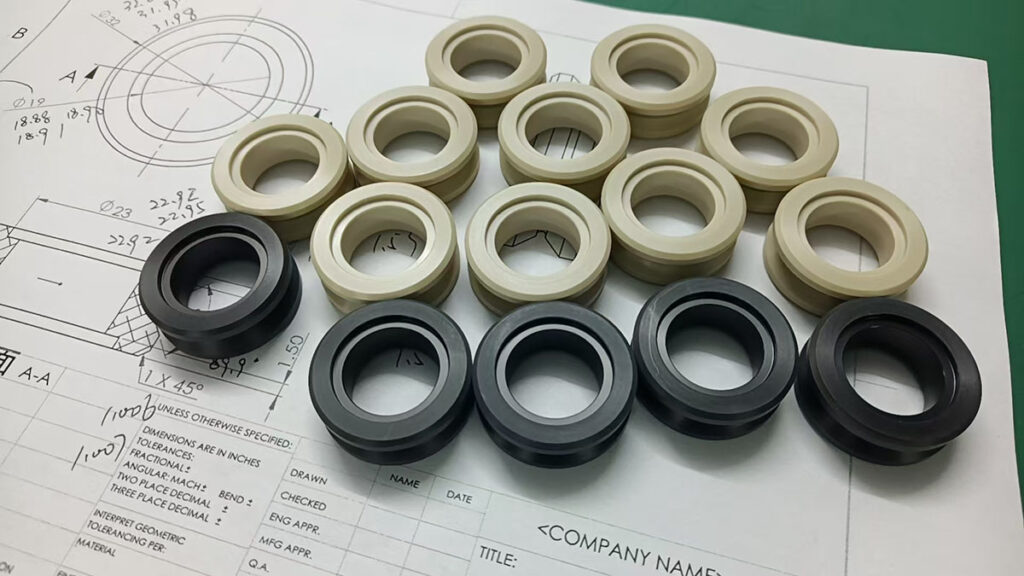
In the world of precision engineering, the choice of material is often the deciding factor between a component that performs reliably for a decade and one that fails prematurely. When it comes to plastic machining, two high-performance thermoplastics consistently dominate the conversation: PEEK (Polyetheretherketone) and Delrin (Acetal).
At first glance, these engineering plastics might seem interchangeable. Both are machinable to tight tolerances, both offer low friction coefficients, and both are widely used to replace metal components. However, their chemical structures, thermal properties, and mechanical behaviors under stress are vastly different.
Whether you are sourcing PEEK machined parts for a critical medical implant or Delrin machined parts for a high-volume automotive assembly, understanding the nuances of these materials is essential. This two-part technical guide will help you make the right choice for your next project.
In Part 1, we will cover the chemistry, thermal limits, chemical resistance, and—most importantly—the raw material forms you can actually buy off the shelf (rods, tubes, sheets, colors, sizes, and pricing).
In Part 2, we will dive into mechanical properties, machining guidelines, application deep-dives, and final selection criteria.
Let’s begin with the fundamentals.
Understanding the Materials: Chemistry and Structure
To appreciate why these two materials perform differently, we must first look at their molecular structure.
Delrin (Acetal Homopolymer)
Delrin is the trade name for acetal homopolymer, a semi-crystalline engineering plastic developed by DuPont. Its molecular chain consists of repeating -CH₂O- units. This structure results in a material with high crystallinity, which translates to excellent stiffness, low moisture absorption, and superior dimensional stability.
Delrin is characterized by:
- High fatigue endurance:It can withstand repeated stress without cracking.
- Low coefficient of friction:It is naturally slippery, making it ideal for moving parts.
- Excellent machinability:It produces continuous chips and does not stress-relieve unpredictably during machining.
PEEK (Polyetheretherketone)
PEEK is a high-temperature, semi-crystalline thermoplastic belonging to the polyaryletherketone (PAEK) family. Its molecular backbone consists of aromatic rings linked by ether and ketone groups. This structure provides exceptional thermal stability and chemical resistance.
PEEK is characterized by:
- High thermal stability:It maintains mechanical properties at temperatures exceeding 250°C (482°F).
- Chemical inertness:It resists virtually all solvents, acids, and hydrocarbons.
- Hydrolysis resistance: It can withstand thousands of hours in steam or hot water without degradation.
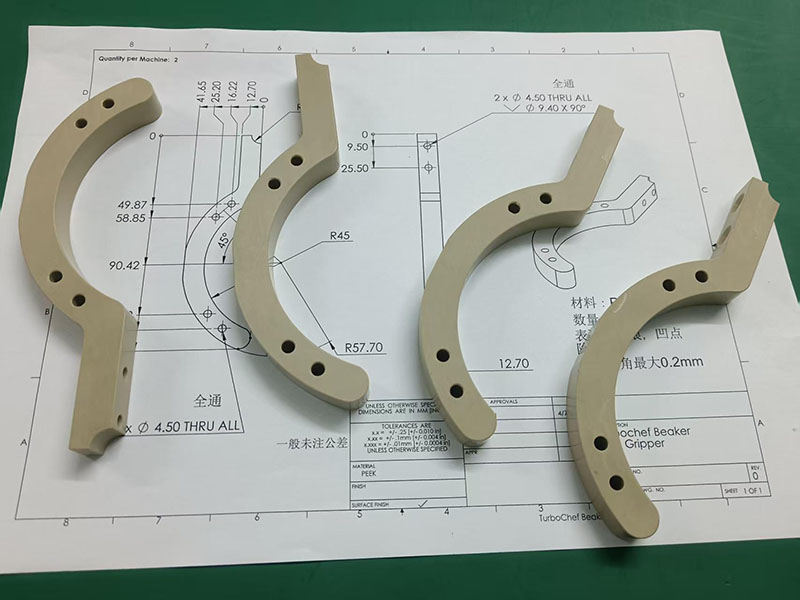
Thermal Performance: A Defining Difference
This is where the two materials diverge most dramatically.
| Materiale | Common Forms | Typical Size Range | Standard Colors | Typical Applications for Each Form |
| Delrin (Acetal Homopolymer) – Unfilled |
Round Rod, Rectangular Bar, Sheet/Plate, Tube | Rod: 1/4″ to 8″ dia. Bar: 1/4″ to 6″ thick. Sheet: up to 48″ x 120″. Tubo: 1/2″ to 6″ OD, wall 1/8″ to 1″ |
Natural (white/off-white), Black | Rods: gears, shafts, bushings. Bars: fixtures, wear strips. Sheets: panels, hoppers. Tubes: sleeves, bearings, fluid handling |
| Delrin (Acetal Copolymer) | Round Rod, Rectangular Bar, Sheet | Rod: 1/4″ to 6″ dia. Bar: 1/4″ to 4″ thick. Sheet: up to 48″ x 96″ |
Natural, Black | Food contact components, better hot water resistance |
| PEEK (Unfilled/Natural) | Round Rod, Rectangular Bar, Sheet/Plate, Tube | Rod: 1/8″ to 8″ dia. Bar: 1/4″ to 2″ thick. Sheet: up to 24″ x 48″. Tubo: 1/4″ to 4″ OD |
Natural (tan/beige), Black | Rods: medical implants, valve seats. Bars: aerospace brackets. Sheets: seals, gaskets. Tubes: catheter components, fluid transfer |
| PEEK (30% Glass-Filled) | Round Rod, Rectangular Bar, Sheet | Rod: 1/4″ to 4″ dia. Bar: 1/4″ to 1″ thick. Sheet: up to 12″ x 24″ |
Light gray, Black | High-stiffness structural parts, reduced thermal expansion |
| PEEK (30% Carbon-Filled) | Round Rod, Rectangular Bar, Sheet | Rod: 1/4″ to 4″ dia. Bar: 1/4″ to 1″ thick. Sheet: up to 12″ x 24″ |
Black only | Bearing components, ESD-safe parts, aerospace components |
Delrin’s Thermal Limitations
Delrin has a continuous service temperature of approximately 80°C to 90°C (176°F to 194°F). At temperatures above this range, it begins to soften, and its mechanical properties degrade rapidly. Delrin also has a relatively low melting point (around 175°C or 347°F), which limits its use in applications involving friction-generated heat or external thermal exposure.
PEEK’s High-Temperature Capability
PEEK is engineered for extreme environments. It has a glass transition temperature of approximately 143°C (289°F) and a melting point of 343°C (649°F). It can operate continuously at 250°C (482°F) without losing its mechanical integrity.
This makes PEEK machined parts indispensable in industries like aerospace components e medical device manufacturing, where sterilization (autoclaving) or high-temperature operating conditions are routine. A PEEK part can endure thousands of autoclave cycles; a Delrin part would fail after a single cycle.
Chemical and Environmental Resistance
Delrin: Susceptible to Acids and Bases
Delrin offers good resistance to hydrocarbons, alcohols, and neutral solvents. However, it is not compatible with strong acids, bases, or oxidizing agents. Exposure to such chemicals can cause surface degradation, cracking, or complete material failure. Additionally, Delrin is not suitable for continuous exposure to hot water or steam, as it is prone to hydrolysis (chemical breakdown by water). Acetal copolymer grades offer slightly improved resistance to hot water and alkalis compared to homopolymer Delrin.
PEEK: Unmatched Chemical Inertness
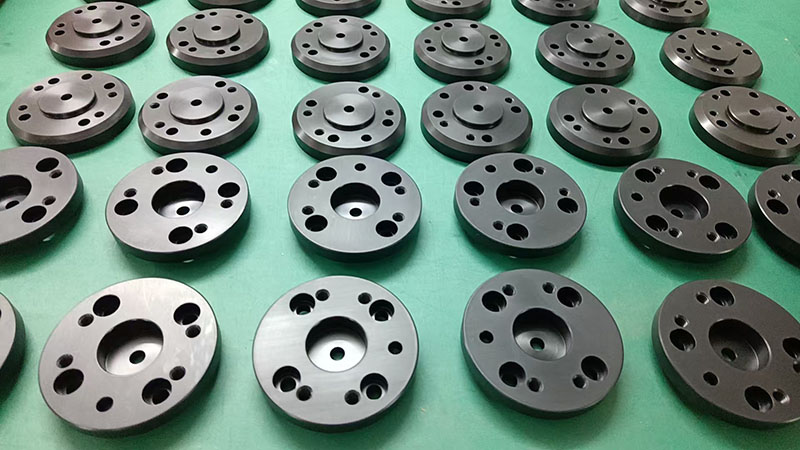
PEEK is one of the most chemically resistant thermoplastics available. It is unaffected by most organic and inorganic chemicals, including strong acids (such as sulfuric acid), bases, and aggressive solvents. It also resists hydrolysis, making it ideal for applications involving steam sterilization, oil and gas exploration, and chemical processing equipment.
For industries requiring sterilizability or exposure to harsh chemicals, PEEK machined parts are the only viable option among these two materials.
Raw Material Forms: What You Can Buy Off-the-Shelf
Before moving into machining considerations, it’s essential to understand what forms of these materials are readily available from distributors. Both PEEK and Delrin are stocked in standard shapes and sizes, making them accessible for Lavorazione CNC operations of all scales.
Procurement Considerations for CNC Machining
- Minimum Order Quantities (MOQs): Delrin has no MOQ; PEEK may require full-length bar purchases.
- Cut-to-Size Services: Available from most suppliers for a small fee—very useful for expensive PEEK.
- Certificazioni: Per medical device manufacturing e aerospace components, ensure COC and ISO 10993 (for PEEK implants) documentation.
- Tempi di consegna: Delrin: 1-2 days. PEEK (especially filled or tube forms): 1-4 weeks.
Now that we have covered the fundamental chemistry, thermal limits, chemical resistance, and raw material sourcing for both PEEK and Delrin, you have a solid foundation for procurement.
But knowing what to buy is only half the battle.
In Part 2 , we will answer the critical questions that impact your actual production:
- How do their mechanical properties (strength, stiffness, wear) compare?
- Which material is easier to machine, and what are the specific machining guidelines for each?
- Where does each material truly excel? (Medical implants vs. automotive gears? Aerospace brackets vs. conveyor components?)
- How do you make the final choice based on your application, budget, and industry requirements?