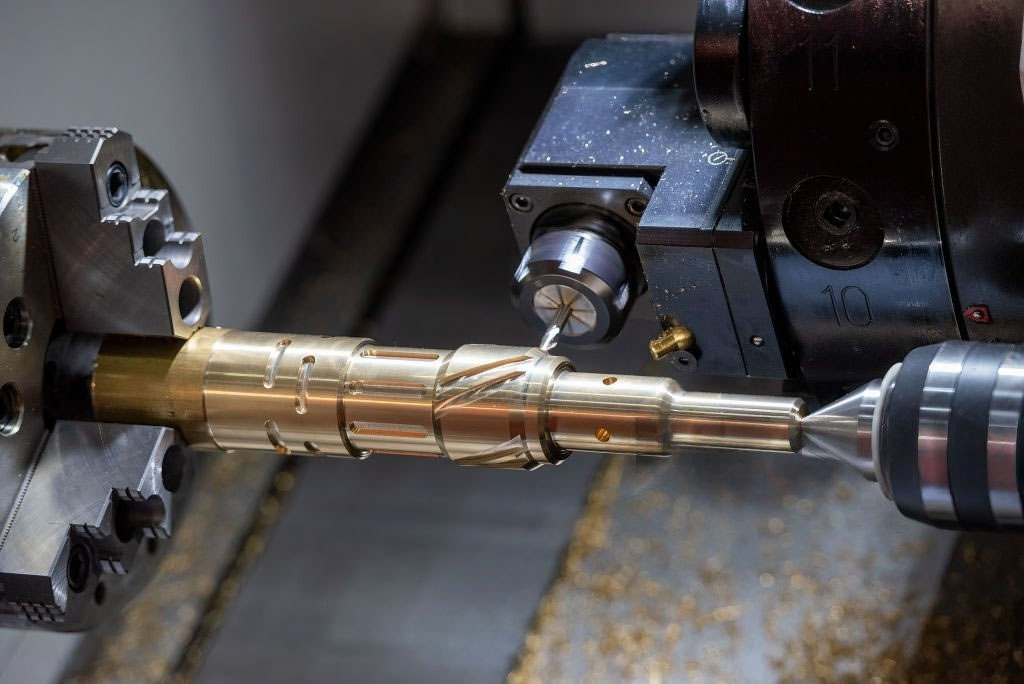
Mechanical failures rarely begin at the center of a component. They start at the joints, seal interfaces, and retention boundaries. Modern industrial machinery demands extraordinary performance under extreme pressure, temperature, and vibration. As a result, engineers must rely on high-precision features to keep critical systems intact. Precision metal grooving serves as the foundation for this mechanical stability.
A grooving operation may look simple on a blueprint. However, cutting a groove into high-strength alloys requires rigorous process control and tooling geometry. Seals, retaining rings, and high-load assemblies depend entirely on exact dimensional control. A tiny variance in wall angle, radius, or surface finish can destroy dynamic seals or dislodge retaining rings. This guide explores the engineering principles, tooling strategies, and production standards necessary to execute flawless metal grooving for critical assemblies.
1. The Engineering Criticality of Precision Grooving
Grooves act as functional features that locate components, maintain pressures, and distribute structural loads. They appear in aerospace hydraulics, automotive powertrains, medical devices, and heavy industrial machinery. Despite their prevalence, machining an internal or external groove presents severe mechanical challenges.
When cutting a groove, the tool enters the material along a narrow profile. Chip evacuation becomes difficult almost immediately. Cutting forces build up at the tip of the tool, generating heat and vibration. If the tool deflects even slightly, the profile geometry suffers.
A poorly machined groove impacts the entire mechanical assembly:
- O-ring shearing: Sharp edges or incorrect depths pinch and destroy synthetic rubber seals during installation.
- Retaining ring dislodgement: Inaccurate wall angles allow retaining rings to slip out under axial load.
- Stress concentration: Sharp bottom radii generate high stress points, causing premature metal fatigue.
- Fluid leakage: Microscopic surface chatter marks allow high-pressure fluids to bypass static and dynamic seals.
Achieving success requires treating grooving as a primary functional feature rather than a simple secondary operation. Machinists must balance feed rates, spindle speeds, and coolant pressure to maintain absolute geometric accuracy.
2. Advanced Grooving Geometry for High-Performance Seals
Seals prevent fluid loss and isolate hazardous environments. Whether housing elastomeric O-rings, PTFE lip seals, or metallic C-rings, the groove must hold precise dimensions. Seal failure often traces back to incorrect groove volume or poor surface conditioning.
Sizing and Volume Calculation
An elastomeric seal must deform under pressure to block fluid paths. However, the seal requires adequate room to expand within its groove. Engineers must calculate the squeeze percentage and gland volume fill accurately. If the groove is too small, the seal overfills the cavity and ruptures. If the groove is too wide, the seal moves excessively and wears out through friction.
Corner Radii Control
The bottom corners of a seal groove require careful radial blending. A perfectly sharp internal corner creates a massive stress riser. This stress causes fatigue cracks in highly pressurized blocks. Conversely, an oversized radius prevents the seal from seating flush along the bottom face. Toolmakers must grind custom insert radii that match the exact engineering drawing specifications.
Surface Finish Specifications
Surface finish directly governs seal longevity. Dynamic seal grooves require an extremely fine surface finish, often down to Ra 0.4 micrometers. Rough sidewalls cause abrasive wear on moving seals during cyclic operations. Machinists achieve these fine finishes through secondary wiper insert passes, micro-burnishing, or specialized polishing techniques.
3. Retaining Ring Grooves and Axial Load Retention
Retaining rings, or circlips, secure components onto shafts or inside housing bores. They absorb significant axial thrust forces during operation. The strength of a retaining ring assembly depends almost entirely on the integrity of its mating groove.
Wall Angle Precision
The load-bearing wall of a retaining ring groove must remain perpendicular to the axis of rotation. Most industrial standards require a maximum wall angle deviation of less than one degree. If the wall angles outward, axial thrust forces create a wedging effect. This force expands the retaining ring, causing it to pop out of place under load.
Depth Tolerances
Groove depth determines how far the retaining ring seats into the metal. Too shallow, and the ring lacks sufficient shear area to withstand thrust forces. Too deep, and the ring sinks completely into the shaft, disengaging from the mating hub. Modern CNC turning centers utilize high-precision touch probes to ensure exact depth tracking across production batches.
Burr Management
Grooving tools push material toward the edges of the cut as they penetrate the workpiece. This movement creates micro-burrs along the outer lip of the groove. Left unchecked, these burrs prevent the retaining ring from seating flat. Precision grooving processes must include automated deburring passes using chamfer tools or nylon filament brushes within the machining sequence.
4. Grooving Strategies for High-Load and Extreme Assemblies
High-load assemblies operate under massive mechanical forces, rapid temperature shifts, and corrosive environments. Components in these applications often utilize tough, heat-resistant alloys such as Inconel, Titanium, and Stainless Steel. Machining precise grooves in hard materials requires specialized strategies.
Managing Work Hardening
High-temp alloys tend to work-harden rapidly under heat and friction. If a grooving tool rubs without cutting, the metal hardens instantly. The next pass then breaks the cutting edge. Machinists counter this issue by maintaining a constant, aggressive feed rate. They use rigid toolholders that prevent deflection under heavy cutting loads.
Chip Evacuation in Deep Grooves
Deep grooving operations trap heat and swarf inside the narrow cut. Recirculating chips scratch the groove walls and snap delicate carbide inserts. High-pressure coolant delivery systems solve this challenge. Delivering coolant at high pressure directly through the toolholder breaks long chips into small segments. This fluid force flushes swarf clear of the cutting zone immediately.
Tool Material and Coating Selection
Uncoated carbide tools wear down quickly when grooving tough alloys. Machinists select specialized Physical Vapor Deposition coatings such as Titanium Aluminum Nitride. These coatings provide extreme thermal resistance and reduce friction. For ultra-hard steel components above 50 HRC, Cubic Boron Nitride inserts deliver smooth surface finishes without needing grinding operations.
5. CNC Machining Techniques and Toolpath Optimization
Executing complex grooving operations on modern CNC lathes and turning centers requires sophisticated toolpaths. Linear plunging straight into a part is no longer the industry standard for precision applications.
Peck Grooving
When cutting deep or wide grooves, peck grooving prevents chip packing. The tool plunges a small distance into the metal, retracts slightly to break the chip, and plunges again. This technique controls heat accumulation and protects fragile tool geometry.
Plunge Turning and Radial Trochoidal Turning
Plunge turning moves the insert axially across the workpiece after the initial plunge. This strategy removes large material volumes quickly while producing excellent flat surfaces. For extremely hard materials, trochoidal toolpath strategies roll the tool into the cut along a curved path. This approach keeps cutting forces constant, dramatically extending insert lifespan.
In-Process Inspection
Automated manufacturing relies on real-time feedback. Integrated machine vision and touch-probe systems measure groove dimensions while the part remains clamped in the chuck. If a tool wears down, the CNC machine adjusts offsets automatically. This process loop guarantees total repeatability across thousands of components.
6. Material Considerations in Precision Grooving
Different metals behave uniquely under the intense pressure of a grooving insert. Tool selection, cutting speed, and lubrication strategies must adapt to the specific workpiece material.
Aluminum and Soft Alloys
Aluminum moves easily under the tool, but it tends to weld itself to carbide cutting edges. Built-up edge ruins the surface finish of seal grooves quickly. High-rake polished inserts and high-volume emulsion coolants keep the tool tip clean and prevent material adhesion.
Stainless Steels (304, 316, 17-4 PH)
Stainless steel generates significant heat and work-hardens easily. Tough carbide grades with sharp, molded chipbreakers prevent chip bird-nesting around the spindle. Proper chip control protects machine operators and stops surface scarring on finished parts.
Exotic Alloys (Inconel, Hastelloy, Waspaloy)
Nickel-based alloys generate extreme thermal stress at the cutting edge. Machinists use reduced cutting speeds alongside elevated feed rates. Specialized micro-grain carbide substrates absorb mechanical shock without chipping during interrupted grooving passes.
Work with SYM Machining for Precision Grooving Excellence
Precision grooving is a demanding discipline where fractions of a micron dictate overall mechanical success. Your high-load assemblies, fluid systems, and structural shafts require perfect manufacturing execution every time. Compromising on groove geometry risks catastrophic field failures and costly equipment downtime.
SYM-Bearbeitung delivers exceptional precision CNC machining solutions for complex industrial applications. Our facility utilizes advanced multi-axis turning centers, high-pressure coolant systems, and rigorous quality assurance protocols. We machine tight-tolerance grooves in stainless steel, aluminum, Titan, and heat-resistant superalloys with total consistency.
Whether you need intricate seal profiles or high-thrust retaining ring features, our engineering team brings deep manufacturing expertise to your design. We optimize toolpaths, control surface finishes, and guarantee absolute geometric accuracy across every production run. To ensure that your products arrive at their destination in perfect condition, we follow a meticulous packaging process that accounts for the material, shape, and size of the parts.
Elevate your component reliability today. Contact SYM Machining to discuss your project requirements, request a custom quote, and partner with a team dedicated to flawless manufacturing quality.
Verwandte Artikel:
10 Hauptvorteile von Komponenten für medizinische Geräte aus Edelstahl
Der ultimative Leitfaden für bearbeitete Teile für Halbleiteranlagen